Key Takeaways
- Start with positioning and a narrow customer problem, not with a long ingredient wishlist.
- Choose a product path early: adapt a ready formula direction versus commission custom development.
- Treat packaging as part of product performance (compatibility, fill, stability, and claim space)—not only aesthetics.
- Build compliance awareness before artwork lock; U.S. cosmetics rules and drug-classification traps are different problems.
- Use a testing overview to prioritize safety and performance questions; testing is not a logo.
- A written launch checklist beats a vibe-based “ship when it looks ready” calendar.
What starting actually means
Founders often confuse three different projects:
- Brand building — name, story, visual system, channel plan.
- Product building — formula, fill, packaging, stability, claims evidence.
- Company building — entity, banking, insurance, contracts, customer support.
You can run them in parallel, but product and compliance gates should control the public launch date. A beautiful website cannot fix a formula that separates in heat, a pump that fails, or a claim that reclassifies the product as a drug.
A practical definition: you have “started” when you can repeatedly make a consistent product, explain it truthfully, fulfill orders without chaos, and respond to quality or safety questions with records. Everything before that is prototype theater.
Positioning before products
Conclusion first: write the customer and the job-to-be-done before you write the formula brief in your head.
Work through these prompts in plain language:
- Who is this for? Age range is weak. Routine context is stronger: “gym bag body care,” “minimal desk makeup,” “sensitive-scalp wash for hard water.”
- What fails in their current routine? Texture, scent load, time, price, or a missing step.
- What will you refuse to do? If you refuse fragrance, glitter, or ten-step rituals, say so. Constraints create brand memory.
- Where will they buy first? DTC, marketplace, boutique retail, and professional channels need different margins, units, and storytelling.
Turn the answers into a one-page positioning note: customer, problem, promise, proof plan, and non-goals. Keep the first assortment small. One hero plus one supporting item beats five underfunded launches.
Positioning also decides category risk. A soothing moisturizer story is usually a cosmetics path. A “treat eczema” story may push you into drug territory in the United States. Classification belongs in the positioning stage, not after you print boxes.
Ready formula vs custom development
Once positioning is clear, pick a development path.
| Path | Best when | Tradeoffs |
|---|---|---|
| Ready / existing formula direction | You need speed, a proven chassis, and limited differentiation beyond scent, shade, or light tweaks | Less uniqueness; you compete on brand, packaging, and experience |
| Custom development | Your promise requires a specific texture, actives strategy, or sensorial signature | More time, more iteration, more documentation discipline |
| Hybrid | Start from a known base, then customize where the brand promise lives | Requires clear “must change” vs “must keep” lists |
Packaging that matches the product
Packaging fails in boring ways: pumps clog, airless systems starve, jars oxidize sensitive formulas, labels wrinkle in humidity, and shippers crush corners.
Build a packaging checklist tied to formula reality:
- Compatibility — formula vs plastic, liner, pump internals, and decoration inks.
- Dispensing — dose size, leftover product, travel leaks.
- Stability and shipping — heat, cold, vibration, and orientation.
- Claim real estate — enough panel space for required labeling without microscopic fonts.
- Refill or secondary packaging — only if your channel and margin support it.
Design beauty matters, but function is part of brand trust. A gorgeous bottle that fails in a gym bag teaches customers the wrong lesson about your standards.
Align artwork timing with compliance awareness (next section). Changing a responsible-person line or ingredient declaration after a foil run is an expensive lesson.
Compliance awareness before launch
You do not need to become a lawyer to launch responsibly. You do need a compliance map.
“A manufacturer or distributor of a cosmetic is legally responsible for ensuring that a marketed product is safe when consumers use it according to the directions in the labeling or in the customary or expected way.”
For U.S.-oriented cosmetics programs, learn the difference between:
- Cosmetics rules under the FD&C Act (labeling, misbranding concepts, cosmetics vs drug intended use).
- MoCRA-era program rails such as facility registration, product listing, responsible person, and serious adverse event processes—start with FDA’s MoCRA page and MoCRA-related topics on the site FAQ.
- Drug pathways when claims or actives (for example, sunscreen) move the product out of cosmetics-only logic.
Practical founder habits:
- Write claims in a shared doc before packaging design.
- Keep a folder for formula versions, specifications, and change history.
- Name who owns adverse-event intake on day one of selling.
- Read primary sources on the FDA cosmetics hub; do not rely only on social media threads.
Other markets (EU, UK, ASEAN, and others) have their own responsible-person, notification, and labeling systems. If you sell multi-market from day one, budget regulatory time per market instead of assuming one U.S. file travels everywhere.
Confirm legal duties with qualified counsel for your structure; public buyer questions are summarized on the site FAQ for orientation only.
Prink factory note: Guangzhou Prink International Cosmetics Co., Ltd. can discuss formulation and technical information that supports documentation. Facility registration, product listing, and responsible-person duties depend on the legal parties for each product and site. This is not legal advice, and cosmetics are not “FDA-approved” merely because a facility or product appears in a registration or listing system.
Testing overview for first products
Testing answers specific questions. It is not a badge wall.
Common question buckets:
| Question | Typical education direction |
|---|---|
| Will it stay stable? | Stability and packaging compatibility programs |
| Is preservation adequate for this formula and pack? | Challenge / preservation effectiveness thinking with a lab |
| How does skin tolerate it in a controlled screen? | Irritation screening concepts (see related HRIPT education) |
| Does performance match the promise? | Consumer-use or instrumental methods matched to the claim |
| Are microbial controls in place for production? | Manufacturing hygiene and release testing habits |
When to pause and when to move
Pause when:
- Claims and intended use still disagree.
- Packaging is chosen before compatibility is checked.
- You cannot name a responsible person or adverse-event owner for your target market.
- Stability or preservation questions are open for a water-rich formula.
- Your assortment is wider than your budget for inventory and creative.
Move when:
- Positioning fits on one page and the first assortment is small.
- Formula path is chosen and change control is written.
- Label text is reviewed against cosmetics (or drug) rules for the market.
- Intake for quality and safety complaints exists.
- You can fulfill a first production run without improvising lot tracking.
Speed is a strategy only when gates are visible. Invisible gates become recalls, reprints, and trust loss.
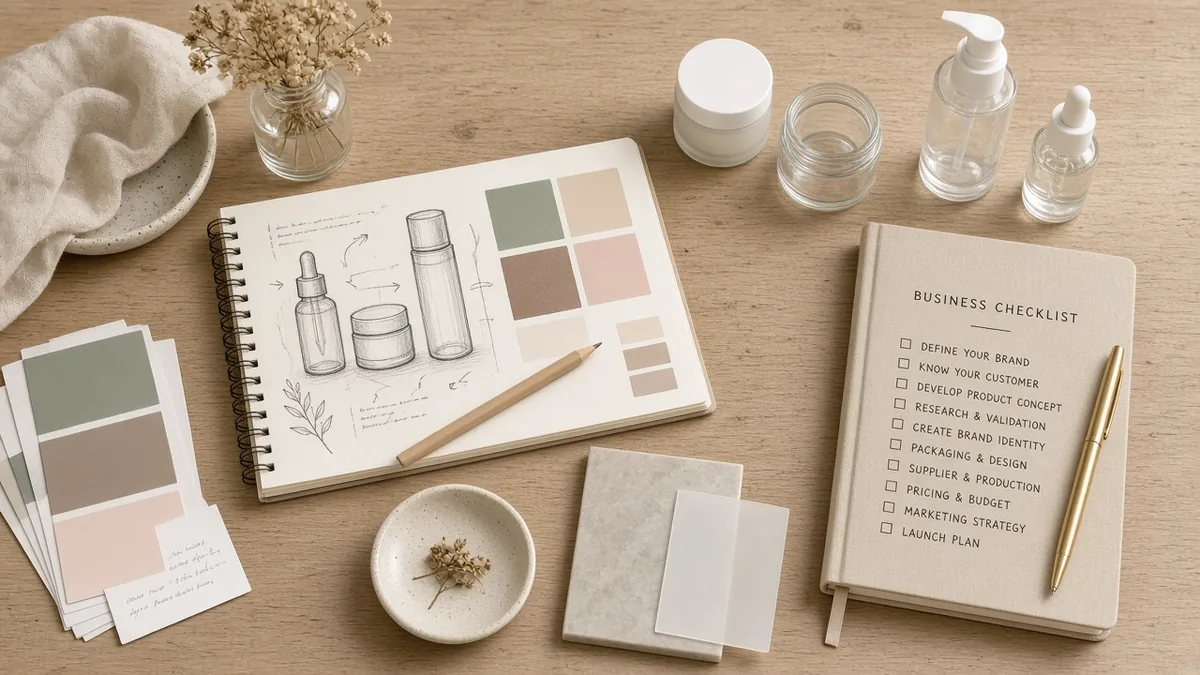
Launch checklist
Use this education checklist before a public sell date.
| # | Item | Done? |
|---|---|---|
| 1 | One-page positioning (customer, problem, promise, non-goals) | ☐ |
| 2 | First assortment limited and sequenced | ☐ |
| 3 | Formula path chosen (ready direction vs custom vs hybrid) | ☐ |
| 4 | Packaging compatibility and dispensing checked | ☐ |
| 5 | Claims and intended use reviewed for classification risk | ☐ |
| 6 | Label content locked (identity, ingredients, required statements) | ☐ |
| 7 | Market compliance map started (U.S. MoCRA rails and/or other markets) | ☐ |
| 8 | Adverse-event / quality intake owner named | ☐ |
| 9 | Priority tests planned and results filed | ☐ |
| 10 | Lot coding, retention samples, and basic traceability ready | ☐ |
| 11 | Customer support scripts for reactions and defects drafted | ☐ |
| 12 | Channel plan matches unit economics and inventory | ☐ |
FAQ
How much money do I need to start?
It depends on assortment size, packaging complexity, testing depth, and channel. A single simple product with modest packaging costs less than a multi-item color line with custom components. Budget for compliance and testing explicitly; they are not optional “phase two” decor.
Should I start with one product or a full routine?
One hero plus optional support is usually easier to fund, explain, and restock. Full routines look impressive in a moodboard and strain cash, creative, and quality systems.
Do I need a custom formula to be a real brand?
No. Customers buy outcomes and trust. A ready formula direction can be a smart first chapter if positioning and packaging are strong. Customize when the promise requires it.
What is the biggest early compliance mistake?
Locking artwork and claims before classification and responsible-person decisions. The second biggest is treating registration or listing myths as “FDA approval.”
When should testing happen relative to photoshoot and launch ads?
After formula and packaging are representative of what you will sell—and before you scale paid acquisition on unverified promises. Photos can be scheduled; evidence should lead public performance claims.
Sources
Related reading
Related reading: oem vs odm cosmetics how to find a cosmetic manufacturer.