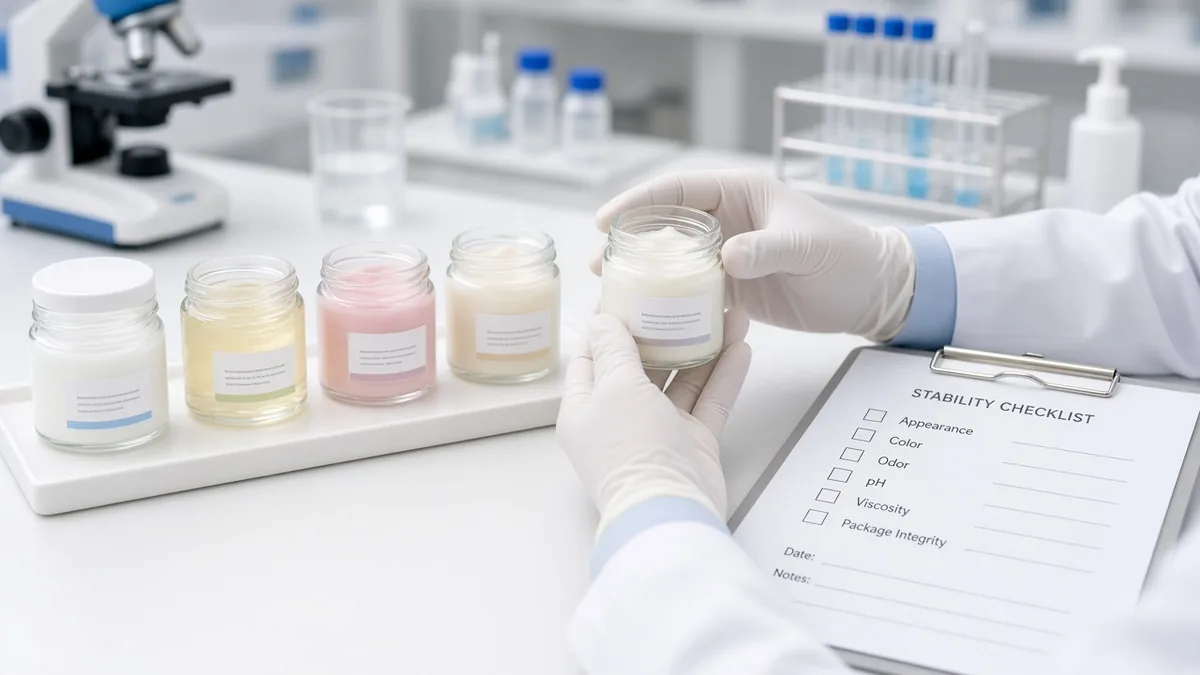
Cosmetic stability testing guidelines help a product team decide whether a specific formula and its intended package remain acceptable under defined storage and stress conditions. The right plan is not a universal temperature-and-time recipe. It should reflect how the product is manufactured, filled, transported, stored, opened, and dispensed. A useful protocol links the exact formula and packaging versions to likely distribution risks, scheduled observations, test methods, and pre-agreed acceptance criteria. That evidence can then support a documented shelf-life decision without pretending that one accelerated condition predicts every market outcome.
Key takeaways
- A stability protocol should answer a product decision, not merely produce a folder of photographs.
- Formula and packaging must be assessed together because leakage, evaporation, swelling, odor transfer, and dispensing failures may appear over time.
- Accelerated observations can expose weaknesses sooner, but they do not automatically prove a fixed market shelf life.
- Record the exact batch, pack, conditions, time points, methods, and acceptance criteria before interpreting results.
- Review the plan after meaningful formula, fragrance, process, or packaging changes.
What should a stability program answer?
A useful program asks whether the product stays within its intended physical, chemical, microbiological, functional, and packaging boundaries for the period and conditions being evaluated. The ISO/TR 18811 cosmetics stability guideline is a better starting point for this question than a drug-only schedule copied from an unrelated product class.
The program should make five things clear:
- Identity: Which formula, batch, fragrance, color, and package were tested?
- Risk: Which changes are plausible during storage, transport, and normal use?
- Conditions: Which real-time or stress conditions were applied, and why?
- Criteria: What counts as acceptable change for each measured attribute?
- Decision: What conclusion can the evidence support, and what remains unconfirmed?
Shelf-life responsibility cannot be outsourced to a generic table. The FDA states:
“FDA considers determining a product's shelf life to be part of the manufacturer's responsibility.” — U.S. Food and Drug Administration
This does not mean every company must invent its own science. It means the evidence must fit the finished product and the claim being made.
Build the protocol around formula and pack risks
Start with the product's likely failure modes. An emulsion may separate or change viscosity. A clear gel may become hazy. A fragranced product may shift in odor or color. A volatile formula may lose mass. A pump may clog even when the bulk still looks acceptable.
The European cosmetic safety framework includes physical and chemical characteristics and stability within the product safety information expected for a finished cosmetic. See Regulation (EC) No 1223/2009 and the related Commission safety-report guidelines. Those sources do not hand every brand one universal protocol; they reinforce the need for a reasoned product-specific assessment.
Define the pack at the same time as the bulk. Relevant questions include:
- Does the container lose mass or allow the formula to dry?
- Does the formula discolor, soften, crack, swell, or extract material from the pack?
- Does the closure continue to seal?
- Does a pump, spray, or valve still deliver a consistent dose?
- Does the label or decoration remain legible under expected handling?
For the broader test portfolio around micro, safety screening, compatibility, and claims, use the cosmetic product testing guide. This page stays focused on stability planning and interpretation.
How do accelerated and real-time observations differ?
Accelerated testing uses selected stresses to make potential changes appear sooner. Real-time testing follows the product under conditions intended to represent normal storage for the target market. They answer related but different questions.
Accelerated observations are useful for comparing prototypes, revealing weak packaging choices, and finding changes that deserve investigation. They are not a magic conversion formula. A product that looks acceptable under one stress condition has not automatically earned a specific shelf-life claim in every climate and package.
Real-time observations provide confirmation closer to normal use, but they take longer. Many programs use both: early stress work supports development decisions, while ongoing real-time work strengthens the final shelf-life rationale.
Avoid copying a standard condition without asking why it fits. Heat, cold, cycling, light, humidity, vibration, and orientation are tools. The risk assessment determines which tools belong in the plan.
What should be measured and recorded?
The exact list depends on the product. The table below is a planning aid, not a universal specification.
| Area | What to observe or measure | Why it matters |
|---|---|---|
| Appearance | separation, haze, sediment, crystals, surface change | shows physical instability or ingredient migration |
| Color and odor | change from the approved reference | may signal oxidation, fragrance change, or interaction |
| pH, when relevant | movement from the approved range | can affect ingredient performance, skin feel, and preservation |
| Viscosity or rheology | flow, structure, thixotropy, dispensing behavior | links bulk structure to use and filling performance |
| Mass or fill level | loss through evaporation or leakage | detects package barrier or closure problems |
| Package function | seal, pump, valve, spray, liner, decoration | confirms the pack still protects and dispenses the product |
| Microbiological risk review | whether preservation evidence and hygiene controls remain applicable | prevents physical stability from being mistaken for microbial control |
“Organoleptic” means observations made with the senses, such as appearance, odor, and texture. “Rheology” describes how a material flows and deforms. Both can be useful, but neither replaces a written method or acceptance criterion.
How should changes and failures be interpreted?
Do not reduce every observation to pass or fail before investigating context. First compare the result with the approved reference and the predefined criteria.
Ask:
- Is the change repeatable across replicates or only one damaged unit?
- Does it affect safety, performance, appearance, dispensing, or only a minor aesthetic attribute?
- Is the change within the product specification?
- Did the package contribute?
- Was the sample prepared, filled, and stored as written?
- Does the result require reformulation, a pack change, a tighter specification, or more data?
A report should not jump from “no visible separation at this time point” to “proved safe for two years.” It should state what was tested, what changed, what met the criteria, and what still needs confirmation.
When should the plan be repeated?
Review the stability rationale after a material change to:
- the emulsion, surfactant, thickener, solvent, or active system;
- the preservative system or target pH;
- fragrance, essential oil, botanical, or color load;
- manufacturing order, shear, heating, cooling, or filling conditions;
- primary packaging resin, liner, closure, pump, or spray system;
- use instructions, target market, or shelf-life claim.
Not every minor change requires a complete restart. It does require a documented assessment of whether earlier evidence still covers the new version. That change-control link is also central to cosmetic formulation.
A practical review checklist
- [ ] Formula code, batch, fragrance, color, and package version are identified.
- [ ] The protocol explains why each condition was selected.
- [ ] Real-time and accelerated observations are labeled separately.
- [ ] Time points and sample orientations are recorded.
- [ ] Methods and instruments are named where measurements are used.
- [ ] Acceptance criteria were defined before the result was interpreted.
- [ ] Packaging compatibility and dispensing function are in scope.
- [ ] Microbiological and preservation evidence are not confused with visual stability.
- [ ] Deviations and damaged samples are documented.
- [ ] The report states limitations and retest triggers.
Prink factory note: the documented sampling path may include sensory review, basic stability observation, and trial filling. In the authorized US-FL-03 project, those records supported a more confident next-step decision before bulk production. Basic observation is valuable development evidence, but it is not a substitute for a product-specific long-term or third-party program.
For emulsion context, see how cream bases are built and reviewed. For the separate microbial-control question, read cosmetic preservatives and challenge testing.
Frequently asked questions
Is accelerated testing enough to set a shelf life?
Not by itself. It can reveal weaknesses and support a shelf-life rationale, but the conclusion depends on the product, pack, conditions, acceptance criteria, and any real-time confirmation plan.
Should packaging be tested with the formula?
Yes. The finished package can change mass loss, odor, color, sealing, dispensing, and material compatibility. Testing bulk in an unrelated container leaves an important risk unanswered.
Does a stable appearance prove microbial safety?
No. A product can look unchanged while microbial controls are inadequate. Preservation and microbiological evidence require their own plan.
What happens when one sample fails?
Document the unit, confirm handling, compare replicates, and investigate the mechanism. Do not hide the result, but do not generalize one damaged unit without checking the evidence.
Evidence and further reading
- ISO/TR 18811:2018 cosmetics stability guideline
- U.S. FDA shelf life and expiration dating for cosmetics
- Regulation (EC) No 1223/2009
- Commission Decision 2013/674/EU
- Cosmetic product testing overview
- Cosmetic formulation stages
- Cosmetic preservatives guide
- Browse ready-to-fill cosmetic bases