Key Takeaways
- Cosmetic product testing is a portfolio of methods—not one certificate that proves a product is finished for every market.
- Common educational tiers include stability, microbial / challenge work, safety screening, packaging compatibility, and claim-support studies.
- Match the method to the decision: shelf-life risk, contamination control, dermal or tox questions, pack interaction, or a specific claim.
- Read the protocol, acceptance criteria, batch identity, and limitations before you treat a conclusion as transferable.
- Keep a written map of which reports cover which claims and markets; gaps are normal until you close them on purpose.
What brands usually mean by these tests
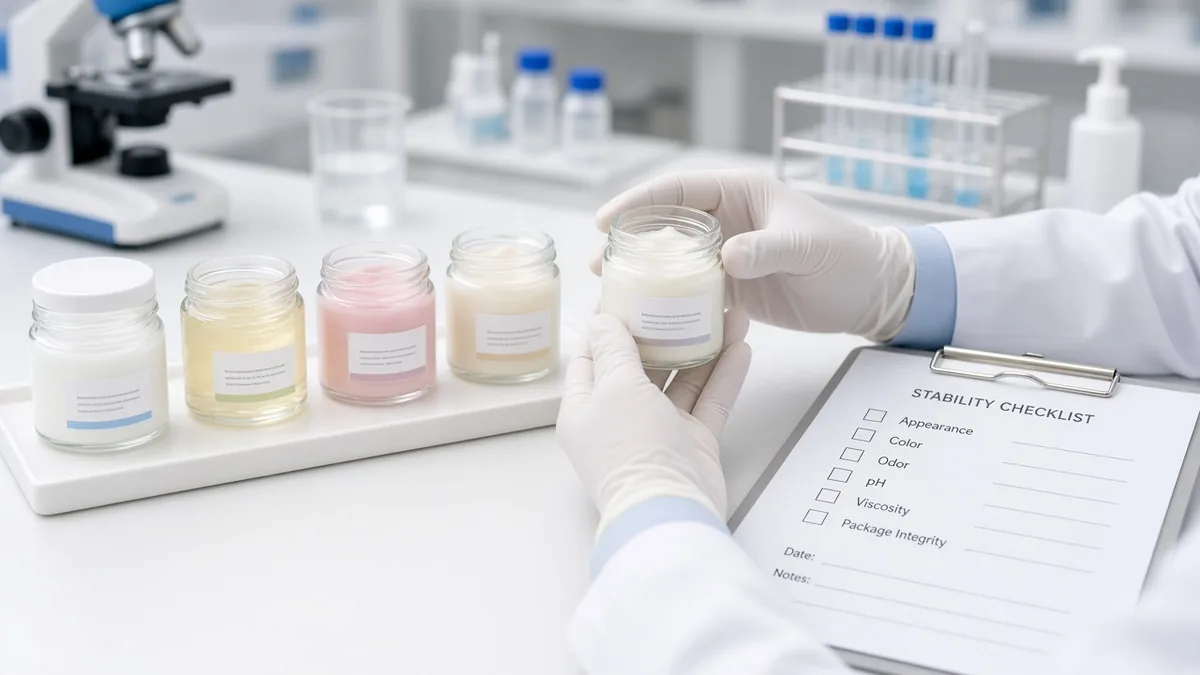
In buyer conversations, cosmetic product testing usually means documented work that answers a concrete product question: Will this formula hold under heat and cold? Can microbes grow if challenged? Is there a screening path for irritation or sensitization risk? Does the formula attack the bottle? Can a claim be supported by a defined study design?
U.S. Food and Drug Administration states:
“Product testing is just one of the things a manufacturer might do to ensure the safety of a cosmetic product.” — U.S. Food and Drug Administration
It does not automatically mean:
- A single lab stamp that equals “FDA approved” for cosmetics (cosmetics are not drug-style pre-approved in the same way as many drugs).
- Proof that every future fragrance, color, or pack change is covered.
- A substitute for labeling, facility, and listing obligations where MoCRA or other local rules apply.
Treat each report as an answer to a scoped question. If the scope is missing, the conclusion is hard to use.
How test tiers differ in practice
Brands often mix methods. The table below is general industry framing—not a lab menu and not invented pass/fail numbers.
| Tier | Core question | Typical outputs buyers see | Easy mistake |
|---|---|---|---|
| Stability | Does appearance, odor, viscosity, separation, or other defined attributes stay acceptable over time and stress? | Time-point tables, photos, storage conditions, acceptance notes | Assuming accelerated data equals real-time shelf life without stated assumptions |
| Microbial / challenge | Is the product microbiologically controlled, and does the preservative system resist challenge organisms under the study design? | Counts, challenge recovery curves, method references | Treating one challenge design as forever valid after formula or fill changes |
| Safety / tox screening | What screening evidence exists for dermal irritation, sensitization risk pathways, or other defined endpoints? | Screening summaries, in vitro notes, or clinical-style study reports when used | Equating any “safe” wording with full safety substantiation for every claim and market |
| Packaging compatibility | Does the formula interact with the pack (leaching, swelling, discoloration, closure issues)? | Pack observations, weight loss, seal checks | Skipping pack tests after a resin or liner change |
| Claim support | Does a defined study design support a specific performance or consumer-perception claim? | Protocol, endpoints, stats summary, claim wording limits | Stretching a narrow endpoint into a broader marketing line |
When each tier usually matters
Stability matters whenever shelf life, shipping climate, or “does it separate?” is a live risk—especially with emulsions, gels, sticks, and any formula that changes viscosity with temperature.
Microbial / challenge matters for water-containing products, multi-use jars, and any pack that invites finger dip or pump contamination. Anhydrous formats still need a reasoned micro plan; the design may differ.
Safety / tox screening matters when you need documented dermal or toxicology-pathway evidence for the finished formula (or key concentrates) as part of a broader safety file. Screening alone is not the whole file.
Packaging compatibility matters at first pack choice and again after material, liner, pump, or fill-process changes.
Claim support matters only when you plan a claim that needs study-backed wording. No study, no stretch.
When a tier may wait: early shade trials with no pack decision yet; pure concept mockups with no formula lock; markets where you have not yet defined claims or distribution. Waiting is fine if you track the gap. Shipping without a plan is not the same as a staged plan.
How to read a laboratory report
Start with identity, not the cover letter.
- What was tested? Formula code, batch or pilot lot, fragrance version, and pack (if pack is in scope).
- What method? Named method, in-house SOP ID, or ISO / pharmacopeial reference as stated.
- What conditions? Temperature, humidity, light, inoculation level, panel size, or exposure schedule—whatever the design requires.
- What acceptance criteria? Written before or with the run, not invented after a pretty chart.
- What conclusion is actually supported? “Met protocol criteria under X” is usable. “Safe for all skin types worldwide” is usually marketing language, not a transferable lab conclusion.
- What is out of scope? Look for exclusions: different fragrance, different preservative level, different pack, or different use instructions.
If the PDF lacks batch identity or acceptance criteria, ask for a corrected or clarified report before you file it as evidence.
Prink factory note: Project documentation available for a given batch can include a Certificate of Analysis (COA) and Safety Data Sheet (SDS/MSDS), among other files agreed for the project. A COA records results against specified batch criteria; it does not by itself prove full safety, stability, or market compliance. MoCRA-related formulation and technical information can be discussed to support a customer’s U.S. compliance work—the legal obligations remain with the relevant parties for that product. See our FAQ for the same boundaries.
Buyer checklist before you file a report
Use this as an education checklist for your product file—not as a manufacturer sampling form.
- Primary market and product category are written down (leave-on, rinse-off, eye area, kids, etc.).
- Formula version and fragrance / color variant IDs match the report cover page.
- Pack components in the report match the pack you will ship (or pack is explicitly out of scope).
- Stability conditions and time points are listed; accelerated vs real-time is labeled.
- Microbial method and (if used) challenge organisms are named.
- Safety or claim studies state endpoints, not only a marketing headline.
- Acceptance criteria appear in writing.
- Limitations / out-of-scope notes are copied into your claim map.
- Retest triggers are listed (formula, fragrance, preservative, pack, process change).
- Responsible owner for MoCRA or local safety substantiation is named on your side (see MoCRA compliance overview).
How often to revisit the testing map
Revisit when any of these change:
- Formula chassis, active level, or preservative system
- Fragrance or essential-oil load
- Primary pack resin, liner, pump, or fill temperature
- Claim set or use instructions
- Target market regulatory expectations
A calendar reminder alone is weak. Tie retests to change control: if the input changed, the old report’s scope may no longer cover the product you are shipping.
Common report myths that create risk
Myth: “We have a COA, so we are done.” Reality: A COA is batch conformance against listed specs. Stability, micro challenge, pack, and claim studies answer different questions.
Myth: “One clinical-sounding PDF covers every claim.” Reality: Endpoints are narrow. A hydration instrument reading does not automatically support an anti-acne drug-style claim—and drug/cosmetic classification questions belong with qualified counsel and FDA cosmetics resources.
Myth: “Accelerated stability always equals 24-month shelf life.” Reality: Labs use models and assumptions. Record them. Confirm whether real-time confirmation is planned.
Myth: “Packaging looks fine on day one.” Reality: Swelling, odor pickup, and leakage often show after stress or time. Compatibility is a timed observation, not a glance.
FAQ
Is cosmetic product testing the same as FDA approval?
No. For most cosmetics, the U.S. framework emphasizes safety substantiation, truthful labeling, and MoCRA-era facility/product listing duties for covered products—not a universal pre-market “FDA approved” stamp like many drugs. Start from the FDA cosmetics hub and confirm obligations for your product.
Which test should we run first?
Lock the formula and intended pack early enough that stability and micro plans are meaningful. Safety screening and claim studies follow the claims and exposure profile you actually intend. Sequence is a project decision; the order above is a common logic, not a law.
Can we reuse last year’s reports after a fragrance change?
Often not for the affected scopes. Fragrance can change odor stability, irritation risk pathways, and sometimes micro or pack interaction. Treat fragrance change as a retest trigger unless a qualified reviewer documents why an old report still covers the new formula.
Does packaging compatibility replace stability?
No. Pack studies ask whether the container and formula fight each other. Stability asks how the product attributes hold over time and stress—often in that pack, but still a different dataset.
Who owns MoCRA safety substantiation?
The responsible parties named under MoCRA for that product. Manufacturing partners may share technical data; they do not automatically become your legal “responsible person.” Read the MoCRA overview and align roles in writing.
What if a report says “pass” but the method is unclear?
Ask for the method ID, acceptance criteria, and sample identity before you rely on it. An unclear pass is weak evidence.
Sources
Related reading
Related reading: cosmetic stability testing guidelines.