Key takeaways
- An emulsifier helps form and maintain an emulsion; it does not make oil and water the same liquid.
- Oil-in-water and water-in-oil systems have different surrounding phases and need suitable emulsifying systems.
- A thick cream is not automatically a stable cream. Thickness and droplet stability are related but different questions.
- Choose the emulsifying system for the complete formula and process, then evaluate the finished product.
What happens when oil and water form an emulsion?
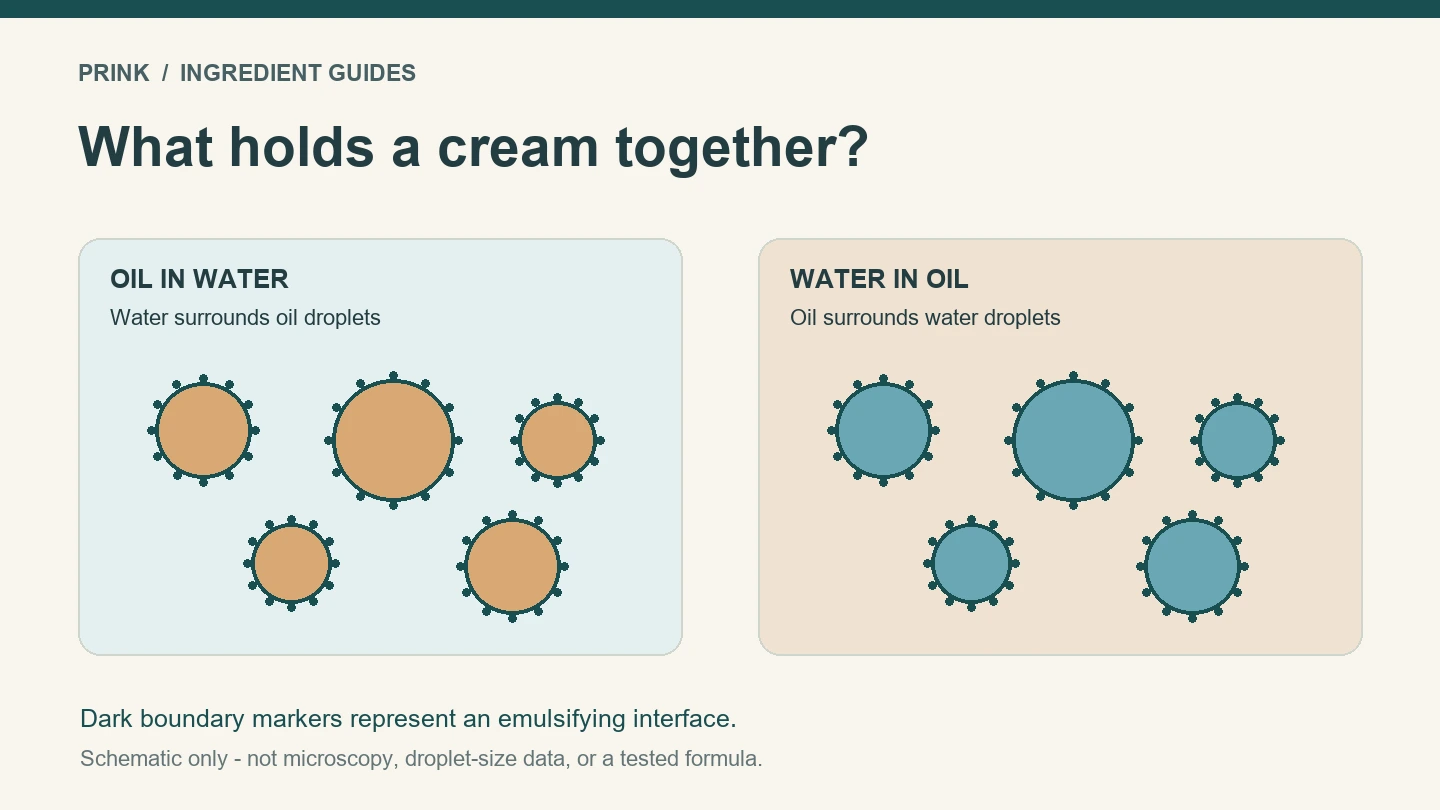
One liquid is distributed as small droplets within another. The liquid around the droplets is called the continuous phase. That term simply means the phase that extends through the surrounding space.
Shaking oil and water can temporarily break one into droplets. Once mixing stops, those droplets can move, gather, and merge. A suitable emulsifying system helps the mixture resist that return toward separation.
In their ACS Omega review of cosmetic emulsifiers, Cortes and coauthors explain why emulsification mechanisms, ingredients, and processing need to be considered together.
“a thermodynamically unstable system in which two immiscible liquid phases are mixed.” — Cortes and coauthors
That description concerns conventional emulsions. It does not mean every cream will visibly separate immediately. It means maintaining a useful structure over time requires more than briefly combining the liquids.
Where does the emulsifier work?
Many familiar emulsifiers act at the interface, the boundary where oil meets water. Their structure allows interaction with both phases, helping create and protect the droplet surface.
“Water-loving” and “oil-loving” are useful introductory descriptions. They are not a complete account of every system. Polymeric emulsifiers and particle-stabilized emulsions can work through additional mechanisms, as the Cortes review discusses.
This is why adding any material called an emulsifier is not enough. Its behavior must suit the oils, water phase, other ingredients, and process. The same name on two product labels does not establish that the products have the same emulsion structure.
Our oil-in-water emulsion examples focus on recognizing the finished structure. Here the question is narrower: what helps create and maintain it?
How do the two common structures differ?
The surrounding phase changes. Read the abbreviations from the dispersed droplets to their surroundings.
| Structure | Dispersed droplets | Continuous phase | What to check when choosing a system |
|---|---|---|---|
| Oil-in-water, O/W | Oil | Water | Whether the emulsifier or blend is intended for the proposed O/W formula |
| Water-in-oil, W/O | Water | Oil | Whether the system supports water droplets in the proposed oil phase |
Avoid choosing from the abbreviation alone. O/W is not a promise of a particular lightness, and W/O is not a complete description of how a product will feel. Oils, texture builders, proportions, and processing all matter.
For readers considering how the whole base is made, our cream-base preparation guide covers the broader development task. An emulsifier choice is one part of that task, not the whole recipe.
Is an emulsifier the same as a thickener or solubilizer?
No, although an ingredient can contribute more than one function. Start with the job needed in the particular system.
| Function | Main question it addresses | Why it is not an automatic substitute |
|---|---|---|
| Emulsifier | How do we form and support dispersed droplets? | It does not alone establish texture, preservation, or shelf life |
| Thickener or texture builder | How does the product flow and feel? | More thickness does not prove the droplet interface is adequately protected |
| Solubilizer | How do we incorporate a suitable small amount of a poorly soluble material into a particular system? | Its intended use may differ from stabilizing a cream with a substantial oil phase |
| Emollient | How does the oil component contribute to softness and feel? | An oil is not automatically an emulsifier |
| Preservative system | How is microbial growth controlled under intended conditions? | Physical emulsion stability does not demonstrate microbial protection |
Some polymers affect both texture and stability. That overlap is a reason to read technical information, not a reason to treat all thickeners as emulsifiers.
Preservation is a separate development question. See our introduction to cosmetic preservatives rather than assuming that a smooth-looking cream is protected against contamination.
Which examples are useful to recognize?
Recognize the exact ingredient or blend, then check its intended use. A familiar label name is the start of the assessment.
- Glyceryl Stearate Citrate: an example used in emulsifying systems. Cosphatec's technical overview identifies it in the company's own emulsifier offering. That example does not establish a universal use level or suitability for every cream.
- Cetearyl Alcohol: a fatty alcohol often considered for structure and feel, and sometimes as part of an emulsifying system. Do not assume it is a complete stand-alone system merely because it appears beside an emulsifier in a label.
- Emulsifying wax: a description that can refer to a blend. Confirm its composition and technical specification rather than treating every grade as identical.
For botanical or “natural-origin” options, ask the same functional questions. An origin description does not tell you whether the material will stabilize the intended formula or meet the product's other requirements.
What should you check before choosing one?
Define the product you are trying to make before selecting a material. Otherwise it is easy to choose an attractive ingredient name and discover later that the system does not suit the product.
- Target structure: O/W, W/O, or another defined system.
- Oil phase: which oils are present and how much of the formula they represent.
- Other ingredients: materials that may affect the system, including salts, solvents, and texture builders.
- Process: supplier instructions, mixing sequence, temperature requirements, and available equipment.
- Finished-product goals: flow, application feel, packaging, and the conditions under which the product must remain usable.
Keep supplier recommendations attached to the exact grade. A starting formulation is a development aid; it is not evidence that your changed formula will behave identically.
For sourcing, check the cosmetic ingredients and raw materials collection alongside the material's technical documents. The educational topic here should remain distinct from browsing a supplier catalog.
Why can a cream still separate or change texture?
Because the emulsifier is one part of a system. A mismatch between materials, proportions, process, or storage conditions can change the result.
Visible separation is one warning sign. Other changes, such as an unexpected shift in flow or appearance, can also justify investigation. Avoid trying to diagnose every problem from a photograph or fixing it by adding more emulsifier without understanding the cause.
Prink's authorized VN-HCM-02 texture-adjustment case records a review of the brief, formula adjustment, sample preparation, feedback, and approval. It does not identify a particular emulsifier or document a comparative stability result. Its relevant lesson is the development sequence: a texture target was checked through samples and revisions rather than inferred from an ingredient name.
Use a documented cosmetic stability testing plan for the finished formula and package. A sample that looks uniform on the day it is made has not, by that observation alone, demonstrated a shelf life.
A quick checklist before you commit
- Can you describe which phase surrounds the droplets?
- Does the technical information support the intended system?
- Have you distinguished emulsification from texture and preservation?
- Are you using the exact grade and an appropriate process?
- Do you have sample observations and a plan to assess the finished product?
If one of those answers is missing, the next step is investigation. Naming an emulsifier is not the same as completing formulation work.
Frequently asked questions
Does every cosmetic need an emulsifier?
No. A product without an oil-and-water emulsion has different needs. An anhydrous oil, for example, should not be treated as though it were an ordinary cream.
Can a thickener replace an emulsifier?
Do not assume so. Some materials contribute to more than one function, but increasing thickness alone does not establish that the chosen system will maintain its droplets over time.
Can I replace one emulsifier with another at the same percentage?
Not without checking the materials and developing the revised formula. A one-for-one change can alter processing, structure, texture, or stability. Use the relevant technical information and sample evaluation.
Does a natural-origin option guarantee a better cream?
No. Suitability depends on the whole formula, process, and intended use. Neither origin nor a familiar ingredient name supplies finished-product evidence.
This is general formulation education, not a validated recipe or a test report for a Prink product.