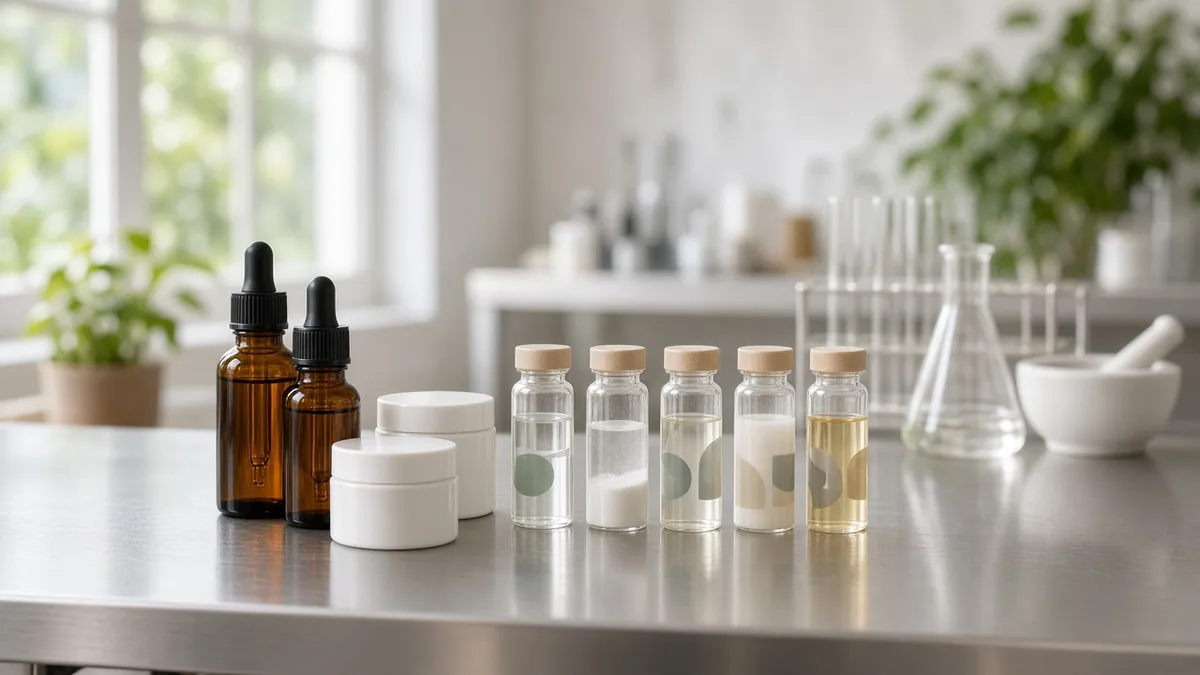
A preservative efficacy test deliberately challenges a cosmetic formula with defined microorganisms and tracks the formulation's antimicrobial protection under a written method. It is also called a preservative challenge test or antimicrobial effectiveness test. The work is tied to a named formula, laboratory procedure, inoculation scheme, sampling schedule, and acceptance criteria. PET does not select a preservative for you, and it is not the same as checking the microbial count of one production batch. Its value comes from showing how a defined product responds over time, while keeping the report's scope and limitations visible.
Key takeaways
- PET asks how the finished formulation responds after a controlled microbial challenge.
- Routine microbial testing asks whether the tested sample meets its release limits at that moment.
- Method, formula identity, product category, time points, acceptance criteria, and deviations control what the report can support.
- A result does not automatically cover a new fragrance, pH target, preservative system, package, or use pattern.
- Use the report as one part of a wider safety and quality file, not as a universal “safe forever” certificate.
What question does PET actually answer?
PET evaluates whether the antimicrobial protection of a cosmetic formulation performs under the selected challenge method. The official ISO 11930:2019 summary describes both a preservation efficacy test and a procedure for evaluating the overall antimicrobial protection of a cosmetic product.
FDA describes cosmetic product testing as one part of a manufacturer's broader safety work:
“Product testing is just one of the things a manufacturer might do to ensure the safety of a cosmetic product.” — U.S. Food and Drug Administration
That wording matters. The test evaluates the formulation as tested. It does not approve a raw material by itself, prove every future variant is covered, or replace manufacturing hygiene.
If you need the ingredient-selection side first, read how cosmetic preservative systems are chosen. This page focuses on the evidence after a system has been formulated into a product.
What happens during the test?
At a high level, a qualified laboratory follows a controlled sequence:
- Confirm the test article. The formula code, batch, package or test container, and use instructions are recorded.
- Prepare the method. The laboratory identifies the standard or SOP, organisms or microbial groups, controls, sampling schedule, recovery method, and acceptance criteria.
- Inoculate the product. “Inoculation” means deliberately adding a controlled microbial challenge.
- Recover and enumerate. At defined time points, the lab recovers and counts viable microorganisms. “Enumeration” means measuring how many viable organisms can be recovered.
- Compare the trend with the criteria. The report interprets the observed reduction or control under that method.
- Document deviations and limitations. Neutralization, recovery, contamination, sample damage, or protocol changes must be visible.
The draft intentionally does not publish a copyable inoculation recipe or universal pass numbers. Those details depend on the selected method, product category, and laboratory protocol.
How is PET different from routine microbial testing?
The two tests answer different questions.
| Question | PET / challenge testing | Routine microbial testing |
|---|---|---|
| What is being asked? | Can the formulation control an introduced challenge under the method? | What is the microbial condition of this sample or batch? |
| When is it used? | During development, validation, or after material changes | During incoming, in-process, or finished-product quality control as applicable |
| What evidence matters? | challenge organisms/groups, time points, recovery, criteria, trend | enumeration method, limits, specified organisms, sample identity |
| Can one replace the other? | No | No |
The FDA Bacteriological Analytical Manual Chapter 23 describes microbiological methods for cosmetics. It is useful context for laboratory examination, but a routine count on a batch is not evidence that the preservative system will control a deliberate challenge over time.
The FDA's microbiological safety and cosmetics guidance also reinforces the wider responsibility to prevent harmful contamination. PET supports that responsibility; it does not replace good manufacturing, clean raw materials, suitable packaging, or batch controls.
Where does ISO 11930 fit?
ISO 11930 is a cosmetics-specific reference for evaluating antimicrobial protection. A laboratory report should identify the exact edition, amendment, or validated SOP it used. Do not assume a method because a sales page says “ISO style.”
The European Commission's cosmetic product safety report guidelines discuss preservation challenge information within the wider safety-report framework. The relevant conclusion is not “every product uses the same test.” It is that preservation evidence should fit the product's risk and safety assessment.
Some products may be assessed as lower microbiological risk because of composition, packaging, or use. That decision still needs a documented rationale. “Anhydrous” is not a complete argument if water can enter during use or the product is used with wet fingers.
How should you read a PET report?
Start with traceability, not the word “pass” on the cover.
- Test article: Does the formula code and batch match the product you will sell?
- Variant: Are fragrance, color, active level, and target pH the tested versions?
- Method: Is the standard edition or laboratory SOP identified?
- Challenge: Are the organisms or microbial groups and controls listed?
- Time points: Are the collection times visible?
- Recovery: Does the report explain neutralization and recovery suitability?
- Criteria: Were acceptance rules defined before interpretation?
- Results: Are counts or reductions shown clearly enough to audit the conclusion?
- Deviations: Did anything depart from the method?
- Scope: Does the conclusion state what is and is not covered?
A “log reduction” describes a tenfold-scale change in microbial count. It is a useful way to express a trend, but the required pattern belongs to the named method and product category. Do not borrow a number from an unrelated pharmaceutical or household product.
When should the test be repeated?
Review coverage after a meaningful change to:
- preservative type or level;
- target pH or buffering system;
- water phase, humectants, surfactants, proteins, botanicals, or other materials that can affect availability;
- fragrance, essential oil, or color system;
- manufacturing temperature, addition order, shear, or cool-down process;
- primary package or consumer-use pattern;
- leave-on versus rinse-off positioning;
- dilution instructions or refill format.
The decision is a change-control exercise. Minor changes may be covered by a documented scientific rationale; major changes may require new evidence. The same principle appears in cosmetic formulation and sample approval.
Physical and packaging stability are related but separate. Use the cosmetic stability testing guide for separation, viscosity, odor, color, mass loss, and package-function planning.
What can PET not prove?
PET cannot prove that:
- the product is sterile;
- every manufacturing batch will be contamination-free;
- every market accepts the same safety file;
- every fragrance, color, or package variant is covered;
- consumer misuse can never introduce contamination;
- the product is non-irritating or non-sensitizing.
For a human dermal study with a different endpoint, see what HRIPT testing shows. For the full map of stability, micro, safety, packaging, and claims evidence, see cosmetic product testing.
Prink factory note: For example, in the authorized US-FL-03 project, the testing method used structured samples and test records to support a next-step decision. The standard sampling path may include sensory review and basic stability observation. These activities do not establish preservative efficacy; PET remains a separate specialist path when the product and market file require it.
A report-review checklist
- [ ] Formula, batch, fragrance, color, and pH target match the intended product.
- [ ] Method edition or SOP is named.
- [ ] Challenge organisms or microbial groups are listed.
- [ ] Controls and recovery suitability are documented.
- [ ] Time points and results are visible.
- [ ] Acceptance criteria match the named method and category.
- [ ] Deviations are explained.
- [ ] The conclusion does not exceed the data.
- [ ] Formula and package changes have a retest or coverage rationale.
- [ ] Routine batch micro checks remain in the quality plan.
Frequently asked questions
Is PET the same as a microbial limits test?
No. PET challenges the formulation's antimicrobial protection. A microbial limits or enumeration test measures the microbial condition of the tested sample.
Is challenge testing needed for every cosmetic?
Risk varies. Water activity, composition, packaging, use pattern, and market expectations all matter. A lower-risk decision should be documented rather than assumed from a marketing label.
Can a raw-material preservative supplier's data replace a finished-product test?
Usually not. Supplier data can support formulation work, but the finished formula changes availability, pH, solubility, partitioning, and interaction. The report must cover the product as tested.
Does changing the package require a new PET?
Not automatically, but it requires a review. Packaging can change contamination exposure and consumer contact. Document why earlier evidence still applies or plan new work.
Evidence and further reading
- ISO 11930:2019 antimicrobial protection of a cosmetic product
- European Commission cosmetic product safety report guidelines
- FDA BAM Chapter 23: Methods for Cosmetics
- FDA microbiological safety and cosmetics
- Cosmetic preservatives guide
- Cosmetic product testing overview
- Cosmetic stability testing guide
- Browse preservative and antioxidant ingredients