Key Takeaways
- A cream base is typically an oil-in-water or water-in-oil emulsion structured to feel like a leave-on cream rather than a thin lotion or a hard balm.
- You need a clear oil phase, a water phase, an emulsifier that matches those phases, and a plan for preservation whenever water is present.
- Home kitchen trials teach sensory feel; lab paths add controlled heat, weighing precision, and documented process steps.
- Stability is about whether the cream stays uniform over time and under stress—not about a single overnight “looks fine” check.
- Use an educational checklist before you call a trial “done,” and treat all numbers here as general guidance only.
What is a cream base in emulsion terms?
Conclusion first: Cream base is a leave-on emulsion chassis meant to deliver slip, moisture feel, and structure before fragrance, actives, or finishing tweaks.
Emulsion is a mixture of two liquids that do not fully dissolve in each other, held as droplets with help from an emulsifier. In practice, most modern face and body creams are oil-in-water (O/W): tiny oil droplets dispersed in a continuous water phase. Some richer creams or cold creams lean water-in-oil (W/O): water droplets in a continuous oil phase. The continuous phase dominates first feel—water-continuous creams often feel fresher; oil-continuous systems often feel more occlusive.
Emulsifier is an ingredient (often a surfactant system) that helps keep those droplets from quickly separating again.
A “base” in learning language means the chassis that already has:
- Emulsification that holds together after cool-down
- Enough structure to sit in a jar or pump without pouring like water
- A sensory target (light cream, rich cream, gel-cream hybrid)
It does not automatically mean a finished, labeled retail product. Labeling, claims, and safety responsibilities still apply when you sell cosmetics. For U.S. orientation on cosmetics vs drugs and labeling themes, use the FDA cosmetics hub. This article does not measure any commercial formula.
If you are still comparing finished textures rather than building emulsions, what is body butter explains how rich body textures sit next to lotion and cream on the shelf.
Which building blocks go into a cream emulsion?
Think in roles, not brand-name buzzwords.
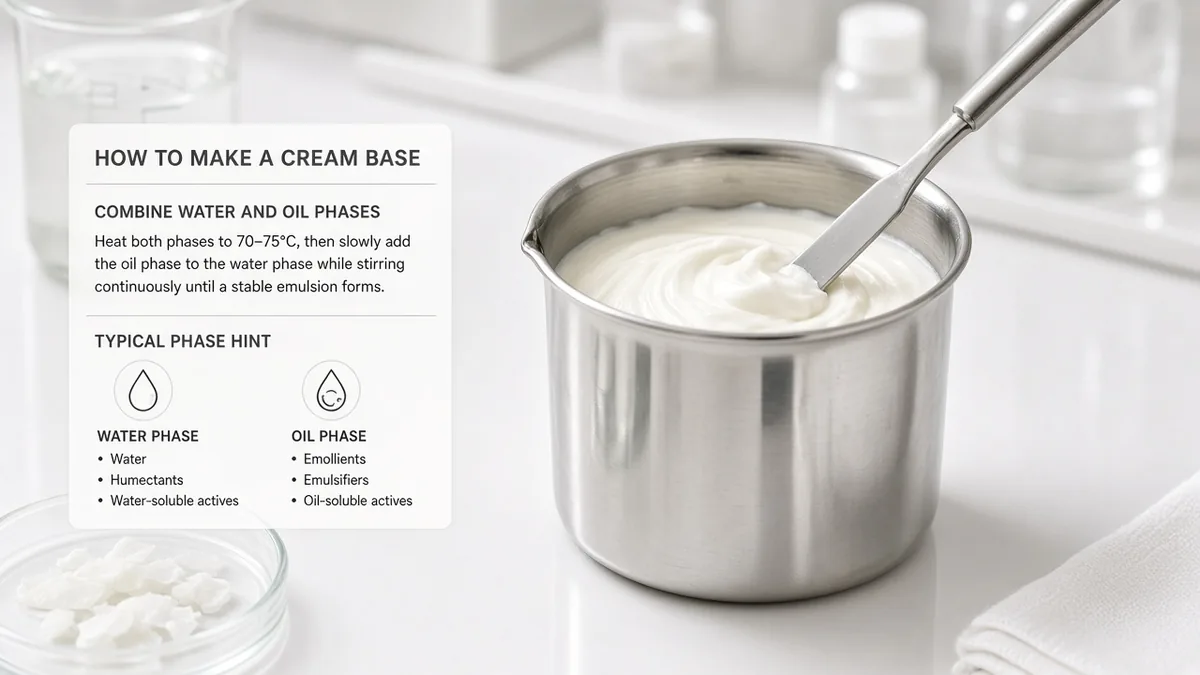
Water phase (general)
- Water or other polar liquids
- Water-soluble humectants (for example glycerin-type materials)
- Water-phase thickeners or gum systems when used
- Water-soluble actives or extracts (if any)
Oil phase (general)
- Emollient oils and esters
- Butters or waxes that raise structure
- Oil-soluble antioxidants or vitamins (if used)
- Fragrance oils when added in oil (timing varies by process)
Emulsifier system
- One or more surfactants designed to stabilize droplets
- Sometimes a co-emulsifier or consistency factor that thickens the interface or continuous phase
Optional structure aids
- Fatty alcohols, waxes, or polymer thickeners that build body after cool-down
Preservative system (when water is present)
- A preservation approach suited to the formula’s water activity, pH range, and packaging—chosen with real compatibility and challenge testing in serious development. This guide does not invent preservative percentages.
Takeaway: cream making is phase design plus process. Mixing oil and water without a suitable emulsifier and process usually yields separation, not a cream.
Original insight (factory intake pattern, qualitative): learner and brand briefs fail most often when “cream base” is requested without stating emulsion type (O/W vs W/O), target finish, and whether water is present—because preservation and stability questions change as soon as a polar phase enters the jar. This is an intake pattern, not a measured lab result for a named SKU.
How do oil, water, and emulsifier work together?
Conclusion first: the emulsifier lowers interfacial tension and helps create a film around droplets so the dispersion lasts long enough to be useful.
A simplified learner sequence:
- Decide emulsion type (usually O/W for everyday face/body creams).
- Heat phases separately when the emulsifier and waxes need melt temperature (lab and many home methods).
- Combine phases with shear—mixing energy breaks droplets smaller.
- Cool while mixing so structure builds without trapping giant air pockets (unless a whipped texture is the goal).
- Add heat-sensitive items at cool-down when the process calls for it.
- Evaluate after 24 hours and again after days—not only at the mixer.
Droplet size and continuous-phase viscosity both affect feel and apparent stability. Smaller droplets and a well-structured continuous phase often look creamier. Exact droplet-size targets need instruments and are not provided here.
For face-oriented lighter creams versus richer body finishes, compare sensory goals on face and body collections as texture references—not as copy-paste formulas.
When does a cream-base approach make sense—and when not?
Makes sense when:
- You want a leave-on moisturizer chassis for face or body learning
- You need a platform to test fragrance level, finish, or active add-ins later
- You are comparing lotion-like vs cream-like structure on purpose
Less suitable when:
- You only need an anhydrous balm or oil (no emulsion required)
- You expect pharmacy-grade claims or disease treatment (cosmetics rules differ; see FDA cosmetics materials for U.S. framing)
- You cannot control cleanliness, weighing, or preservation for a water-containing trial
- You need validated shelf life for sale without lab support
Takeaway: use cream-base learning for emulsion literacy. Do not treat a kitchen batch as automatically market-ready.
| Topic | Home / bench learner path | Lab / development path |
|---|---|---|
| Weighing | Kitchen scale; larger error risk | Analytical or precise top-loading balance |
| Heat control | Pot and thermometer; uneven spots | Controlled water bath or jacketed vessel |
| Mixing | Stick blender or whisk | Overhead mixer, homogenizer options |
| Documentation | Notes optional | Batch record, process parameters |
| Preservation | Often under-tested | Planned system + compatibility + challenge testing |
| Stability | Visual jar checks | Protocol under temperature/time stress |
| Goal | Learn feel and failure modes | Build a reproducible chassis |
How does a home path differ from a lab path?
Home trials are excellent for seeing separation, graininess, and greasy vs fresh finish. They are weak for proving shelf life or microbial safety. Lab paths reduce guesswork but still require evidence—no invented pass/fail numbers appear in this article.
If you later evaluate industrial starting chassis families, bulk bases illustrate how cream and lotion platforms differ as finished sensory starting points for learning conversations.
What should you know about stability and preservation?
Conclusion first: a cream that looks smooth at cool-down can still separate, thin out, or grow microbes later.
“Cosmetics are required to be safe when consumers use them according to directions in the labeling, or in the customary or expected way. Product testing is just one of the things a manufacturer might do to ensure the safety of a cosmetic product.”
Common failure modes (educational):
- Phase separation — oil layer or watery serum after rest or heat/cool cycles
- Graininess — wax or butter crystallization that feels sandy
- Viscosity drop — cream becomes runny after days or under warm storage
- Syneresis — watery beads on the surface
- Odor or color shift — oxidation or contamination signals (not a diagnosis by themselves)
General learner checks (not a validated protocol):
- Observe at rest after 24 hours.
- Check again after several days at room conditions you actually live with.
- Optionally compare a warm spot vs a cooler spot—without claiming accelerated aging equivalence to formal studies.
- Note pump or jar behavior: does product spit watery liquid first?
Mark every observation as general guidance / not measured results for a sold formula. Serious brands use written stability and microbiology plans. U.S. sellers should also stay aligned with cosmetic labeling and safety responsibilities described at a high level by the FDA cosmetics pages.
If the formula contains water (or other ingredients that support microbial growth), preservation is part of responsible design—not an optional perfume note. Educational points only: anhydrous balms and water creams do not share the same microbial risk profile; preservative choice depends on composition, packaging, and use pattern; “natural” does not mean self-preserving; challenge testing matters before retail sale. This guide does not recommend specific preservative brands, percentages, or invented setpoints.
What process habits improve learner batches?
Before you mix
- Clean tools and containers; residue from old batches can seed failure.
- Weigh phases; guessing spoils comparisons between trials.
- Decide emulsion type and sensory target in one sentence.
During combination
- Match temperatures when your emulsifier needs melt (general practice).
- Add the dispersed phase into the continuous phase as your method requires—do not reverse steps randomly between trials if you want comparable results.
- Use enough shear to disperse, then reduce speed to limit giant air bubbles if a dense cream is the goal.
After cool-down
- Record feel at 10 minutes, 24 hours, and later.
- Adjust only one major variable per trial when possible (emulsifier level concept, oil blend, thickener)—still without publishing invented formulas here.
Takeaway: process discipline teaches faster than random remixing.
What educational checklist should you run before calling a cream base “done”?
- I can state whether the target is O/W or W/O in plain language.
- Oil phase, water phase, and emulsifier roles are listed separately in my notes.
- Water-containing trials include a preservation plan appropriate to my risk level (learning jar vs anything shared or sold).
- I weighed ingredients instead of estimating by volume alone.
- Heat and mix steps are written so I can repeat them.
- I waited beyond cool-down before judging texture.
- I checked for separation, graininess, and odor change after rest.
- I am not claiming disease treatment or unverified clinical results.
- Label and claim language will follow applicable cosmetics rules if this ever ships (see FDA cosmetics hub for U.S. orientation).
- If the goal is a rich body finish rather than a face cream, I compared sensory expectations with resources like what is body butter.
Prink factory note: teams that later move education into manufacturing trials on existing chassis routes often see a 50 kg minimum order quantity and sampling around 7–15 days—full custom timelines differ and are not guaranteed here.
FAQ
How to make cream base without a lab homogenizer?
Many learners start with controlled heat and a stick blender for small batches. You can still teach emulsion principles that way. Expect less reproducibility and weaker proof of long-term stability than a lab mixer provides. Cleanliness and preservation still matter whenever water is present.
Is a cream base the same as a lotion base?
Not exactly. Both are often emulsions, but cream bases are built for more body and a slower flow. Lotion bases usually target lighter spread and faster dry-down. The difference is sensory design and structure—not a single magic ingredient.
Can you make a cream base with only oil and butter?
You can make an anhydrous balm. That is useful, but it is not the same as an emulsion cream base. Emulsion creams need a water phase (or polar phase) plus an emulsifier system when you want classic cream freshness and structure.
How long should a learner cream stay stable?
There is no universal kitchen number. Judge early failures in days; judge commercial readiness only with documented stability and microbiology work. Anything sold should follow applicable cosmetic responsibilities in your market.
Why did my cream separate overnight?
Common educational causes include weak emulsifier match, incomplete melt of waxy materials, wrong phase addition order, insufficient shear, or cooling too fast without mixing. Fix one variable at a time. This is general troubleshooting, not a measured diagnosis of your batch.
Where do face creams and body creams diverge in base design?
Face creams often prioritize lighter residue, fragrance restraint, and elegant dry-down. Body creams may accept richer films. Use face and body sensory goals as reference points, and read dry-skin selection logic in how to choose a skin moisturizer for dry skin.