Key takeaways
- A body wash cleanses; a body scrub exfoliates. One does not replace the other.
- Most people do well scrubbing at most two or three times a week, with light pressure.
- On a scrub day, wash, scrub, rinse well, then moisturize.
- Redness, stinging or cracked skin are signs to pause the scrub and go back to a gentle wash.
What does each one actually do for your skin?
A body wash is a cleanser. It is built around surfactants, the ingredients that let water carry away oil, sweat and dirt, and it is designed to be used daily. The American Academy of Dermatology (AAD) advises people to "wash your skin with a gentle cleanser" and to keep baths and showers to five to ten minutes in warm water.
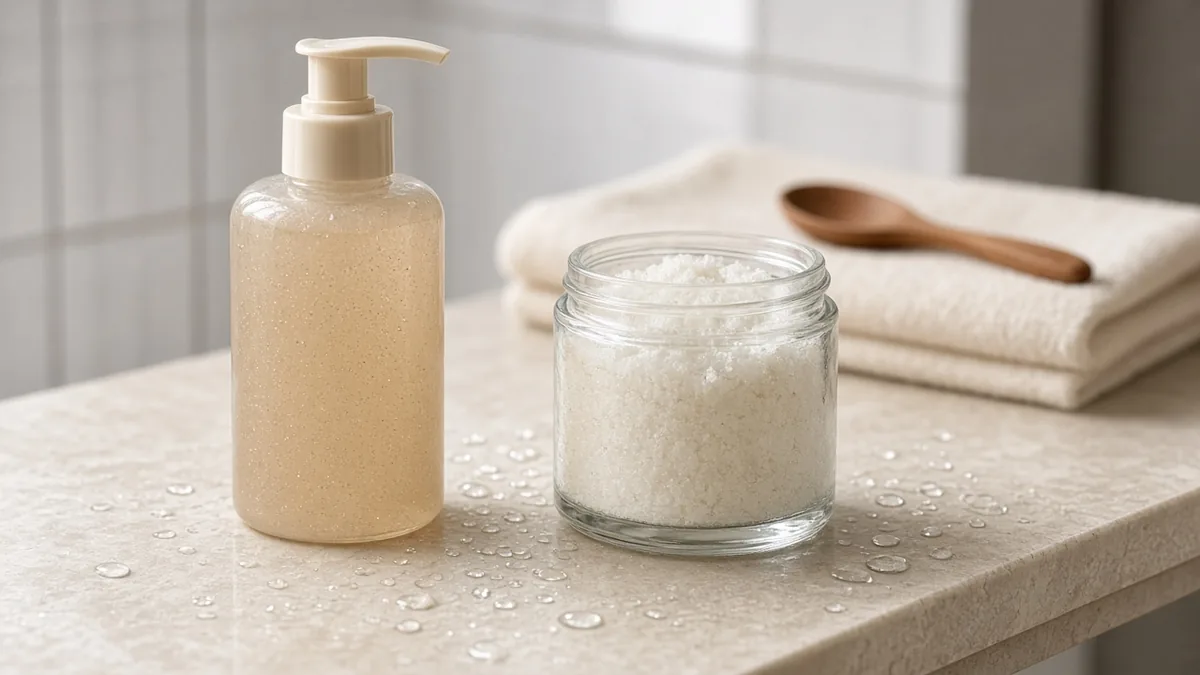
A body scrub is an exfoliator. Exfoliation means removing dead cells from the skin's surface, and scrubs do it in one of two ways:
- Physical scrubs use granules such as sugar, salt or beads. Cleveland Clinic describes physical exfoliation as using "some type of tool or granule-based product to physically remove dead skin."
- Chemical exfoliants use an acid, such as lactic or salicylic acid, to loosen dead cells over hours or days instead of rubbing them off. Most products sold as a "scrub" are physical.
Granule type changes the feel. Sugar dissolves in water and tends to feel softer. Salt is coarser, so it needs a lighter hand. Either way, the granules do the work, so pressure matters more than the product.
| Body wash | Body scrub | |
|---|---|---|
| Main job | Cleanses oil, sweat and dirt | Removes dead surface cells |
| How it works | Surfactants lift away oil and dirt, then rinse off | Granules (or acids) loosen dead cells |
| Texture | Liquid or gel, usually lathers | Gritty, paste-like or gel with particles |
| How often | Every shower | Occasionally, not daily |
| Skin sensitivity | Choose a gentle formula | Easier to overdo on sensitive or dry skin |
| Replaces the other? | No | No |
How do they differ, side by side?
If you are also comparing cleanser formats, our guide to body wash vs shower gel covers the two everyday cleansers. This guide is about cleansing versus exfoliating, which is a different choice.
Can a scrub replace your wash, or the other way round?
No. Treat them as two separate steps.
A wash is formulated to cleanse and rinse clean. Formulators generally build a cleanser around mild surfactants and how it rinses. A scrub adds particles on top of that, and those particles are meant to exfoliate, not to be a gentle daily cleanser. Using a scrub as your everyday wash means abrading your skin every day, which leaves it no time to recover (more on that below).
A wash cannot do a scrub's job either. Cleansing rinses away what is on the surface, but it does not loosen dead cells that are already stuck there. Bar soap sits in the cleanser camp with body wash, so the same logic applies.
Which goes first in the shower?
Sources disagree on this, so here is a simple rule that works and why.
Wash first, then scrub, then rinse well. Cleansing first removes surface oil and sweat, so the scrub is working on cleaner skin and you are not rubbing grit over dirt. Some people prefer to scrub first and then wash to rinse off any leftover granules. Both orders work, and the rinse and the moisturizer matter more than the sequence.
A scrub-day routine looks like this:
- Rinse with warm water, keeping the shower short.
- Wash with a gentle body wash.
- Apply the scrub with light pressure in small strokes. Cleveland Clinic's advice is that "some physical exfoliants are rough by nature, so use light pressure with little strokes."
- Rinse thoroughly so no granules stay on your skin.
- Pat dry and moisturize while skin is still slightly damp. If you are not sure which moisturizer suits you, see body cream vs lotion or body oil vs lotion.

How often should you scrub, and what changes with your skin type?
Less often than most people think. Dr. Rachel Reynolds, a dermatologist at Beth Israel Deaconess Medical Center, told Harvard Health Publishing that people should exfoliate "at most, … two or three times a week," and explained the reason:
"Your skin needs to repair itself in between exfoliation episodes."
— Dr. Rachel Reynolds, dermatologist at Beth Israel Deaconess Medical Center, in Harvard Health Publishing
Cleveland Clinic gives a similar figure for the body: a licensed esthetician quoted there says two or three times a week should suffice for the skin on the rest of your body.
Use that as a ceiling, then adjust:
- Normal skin: start at the low end and add a session only if your skin stays comfortable.
- Dry skin: go lighter and less often, since dry skin loses moisture easily. Scrub gently and moisturize right after.
- Oily or bumpy skin: you can use more of the allowance, but keep the pressure light. Pressing harder does not make a scrub work better.
- Sensitive skin: go slowly and stop if your skin reacts. Dr. Reynolds notes that the abrasives in some scrubs can "go too far."
Dr. Reynolds also cautions that exfoliating can make you more prone to sunburn, so keep sun protection in your routine on scrub days.
What are the signs you are scrubbing too much?
Your skin will tell you. Cleveland Clinic warns that over-exfoliation can cause "redness, irritation or cracked skin." Stinging when you apply moisturizer or a rough, tight feel are the same warning.
If that happens:
- Stop scrubbing until skin feels normal again.
- Switch to a gentle wash and a simple moisturizer.
- Come back at a lower frequency and lighter pressure.
- If irritation lingers or looks severe, ask a clinician rather than trying a stronger product.
Quick checklist: scrub day or wash-only day?
Choose wash-only if any of these is true:
- Your skin feels tight, stingy or sore today.
- You scrubbed in the last two days.
- You have a sunburn, a fresh shave nick, or broken skin.
- You are heading into heavy sun with no sun protection.
Choose scrub day if your skin feels comfortable, you scrubbed a few days ago, and you can moisturize straight after the shower.
FAQ
Which is better, a body scrub or a body wash?
Neither is better, because they do different things. Use a body wash every day and add a scrub occasionally if you want smoother-feeling skin.
Can I use a body scrub every day?
It is best not to. Harvard Health's dermatologist says skin needs to repair between exfoliation sessions, so build in rest days.
Should I use both together?
On a scrub day, yes: wash, scrub, rinse and moisturize. On other days, wash only.
What is best for sensitive skin?
A gentle wash is the safer daily choice. If you want to exfoliate, go slowly, use light pressure and watch for redness or stinging. Check with a clinician if your skin reacts.
Is a body polish the same as a body scrub?
Brands use both names for similar products, so do not rely on the label. Look at the description and ingredient list: granules such as sugar or salt point to a physical scrub, and acids point to a chemical exfoliant. The same frequency and pressure advice applies.
Where to go next
Looking for more body-care guides? Browse our body care formulas or read what is body butter for the next step after the shower.