Key Takeaways
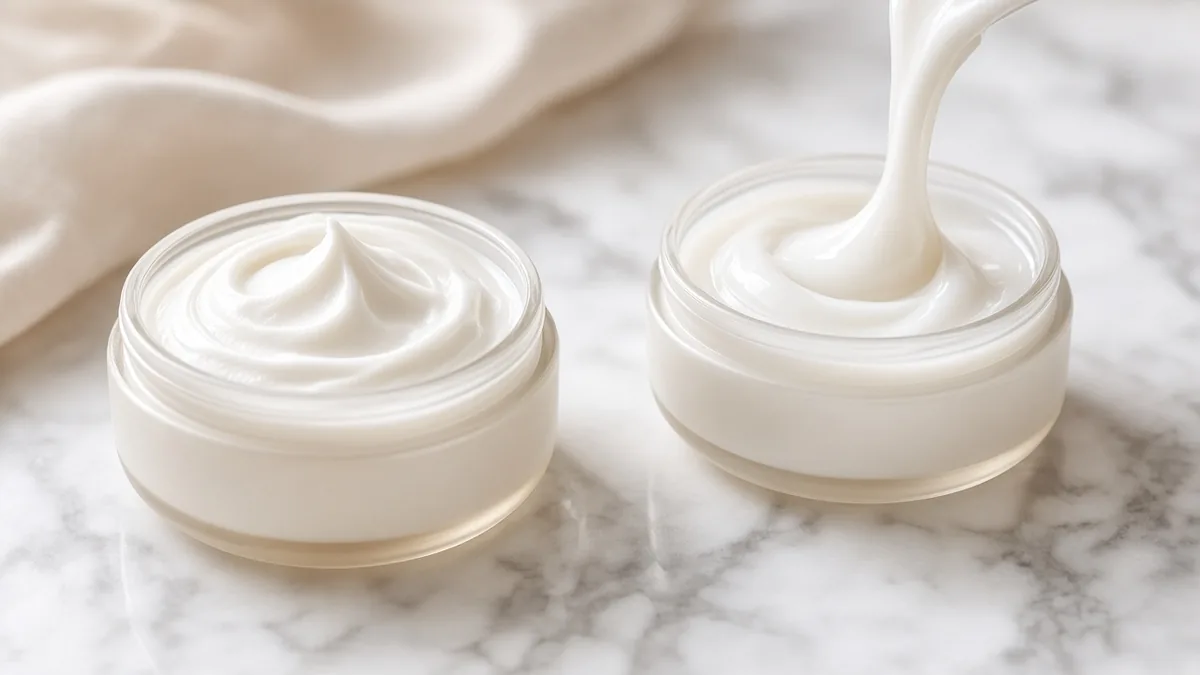
- Body lotion is usually lighter and more fluid. It often spreads quickly and works well for everyday body moisturization.
- Body cream is usually thicker and richer. It often suits drier skin or people who prefer a more substantial after-feel.
- The names are not exact formulas. A lotion can be surprisingly rich, and a cream can be designed to feel lightweight.
- Skin condition matters more than season alone. Dryness, climate, body area, and sensory preference should guide the choice.
- Ingredients still matter. Humectants, emollients, and occlusives can make two products in the same format perform very differently.
What is the main difference?
Body lotion is a leave-on body moisturizer that usually has a fluid, easy-to-spread texture.
Body cream is a leave-on body moisturizer that usually has a thicker, richer, more structured texture.
Moisturizer is a product designed to help maintain or increase water in the outer skin while improving softness and comfort.
DermNet places lotions and creams on the same broad moisturizer spectrum. It describes creams as more occlusive than lotions in general, while lotions are often used for mild dryness or hairy areas: DermNet — Emollients and Moisturisers.
The American Academy of Dermatology makes a similar distinction for dry skin:
“Ointments and creams add more moisture to skin and are more effective than lotions.”
Source: American Academy of Dermatology — Dermatologists’ top tips for relieving dry skin
That does not mean every cream will outperform every lotion.
A well-designed lotion can moisturize very effectively. A poorly balanced cream can still feel unpleasant or fail to meet the user’s needs.
| Feature | Body lotion | Body cream |
|---|---|---|
| Typical texture | Fluid to medium viscosity | Medium to high viscosity |
| Spreadability | Usually spreads quickly over large areas | Usually feels more substantial during application |
| Typical after-feel | Lighter, often less persistent | Richer, often more protective |
| Common use | Everyday body moisturization, mild dryness, warm weather | Dry skin, colder weather, targeted richer care |
| Packaging tendency | Pump, bottle, tube | Tube, pump, jar, or tub |
| Occlusive feel | Often lower | Often higher |
| Best choice | Depends on finished formula and user preference | Depends on finished formula and user preference |
How do they compare at a glance?
These are general format tendencies, not fixed technical rules.
The product name does not tell you the exact oil content, emulsion type, or moisturizing performance.
For formula evaluation, “lotion” and “cream” are useful sensory labels, but weak technical specifications. Viscosity, lipid phase, rheology, and occlusive system give a clearer picture.
Is lotion always more water-based than cream?
Usually, lotions are designed to feel more fluid and often contain a larger aqueous proportion than richer creams. But there is no universal percentage that separates the two categories.
A review of cosmetic moisturizer vehicles describes body lotions as commonly oil-in-water emulsions. It also shows that creams can be oil-in-water systems: Vehicles for Drug Delivery and Cosmetic Moisturizers: Review and Comparison.
More recent formulation research shows why fixed rules are risky.
A 2025 analysis of different medicinal emollients found overlap between products labeled lotions and creams. It also included both oil-in-water and water-in-oil products within those commercial format names: How to Choose an Emollient? Pharmaceutical and Sensory Attributes for Product Selection.
So statements such as “cream is always 50% oil” or “lotion is always a specific water percentage” should not be treated as universal definitions.
For a deeper explanation of emulsion structure, see how to make cream base. That article focuses on formulation process rather than body-moisturizer selection.
Which is better for dry skin?
Cream is usually the stronger starting choice when skin is clearly dry, rough, or tight.
The AAD recommends creams or ointments rather than lotions for very dry skin. Creams usually provide a richer combination of emollient and occlusive effects.
That can be useful on:
- dry lower legs
- elbows
- knees
- hands
- areas that feel rough after bathing
- skin exposed to cold or low-humidity conditions
A lotion can still work for dry skin if the formula is well designed.
For example, a lotion may contain glycerin, dimethicone, ceramides, petrolatum, shea butter, or other ingredients that support moisture retention.
A 2025 comparative study tested one moisturizing lotion and one moisturizing cream on the arms. Both improved measured skin hydration over the study period: PubMed — Utilization of a Heatmapping Python Program to Visualize Improvements of Skin Hydration After Use of a Moisturizing Lotion or Cream.
That study does not prove lotions and creams are equivalent as categories.
It does reinforce an important point: finished-product performance cannot be predicted from the format name alone.
Which is better for normal or oilier-feeling body skin?
A lotion is often the more comfortable choice when you want moisture without a heavy finish.
It can work well when:
- your skin is not very dry
- you moisturize large body areas every day
- you dislike a persistent rich film
- the weather is warm or humid
- you want a product that spreads quickly
- body hair makes thick products harder to distribute
DermNet specifically notes that lotions are often used for mild dryness and hairy areas.
Still, oily-feeling skin can become dehydrated or locally dry.
The decision should be based on how the skin feels and responds, not on a rule that oily skin must avoid creams.
Does weather change which one you should use?
Yes, climate can change which texture feels appropriate.
Cold weather and low humidity often increase dryness. A cream can provide a more protective feel under those conditions.
Warm, humid weather often makes lighter lotions more comfortable.
This does not mean everyone needs to switch products twice a year.
A person with very dry skin may prefer cream year-round. Someone with comfortable skin may use lotion through winter without a problem.
The most useful rule is:
Adjust richness when your skin condition changes, not simply because the calendar changes.
Do ingredients matter more than texture?
Yes. Texture tells you how the product feels; ingredients help explain how it moisturizes.
Most moisturizers combine three functional groups:
Humectants
Humectants help attract or retain water in the stratum corneum.
Common examples include:
- glycerin
- hyaluronic acid
- urea
- panthenol
Emollients
Emollients help soften and smooth rough skin.
Examples can include:
- fatty alcohols
- esters
- plant oils
- squalane
- some butters
Occlusives
Occlusives form a hydrophobic surface film that slows water loss.
Examples include:
- petrolatum
- mineral oil
- dimethicone
- paraffin
- some waxes
DermNet describes humectants, emollients, and occlusives as core moisturizer components.
The balance between them often matters more than whether the front label says lotion or cream.
For a deeper explanation of surface sealing and TEWL, see occlusive skincare once that guide is available on the site.
Want the emulsion building blocks behind either texture? See what is body lotion made of.
To compare formulas by function as well as texture, read our guide to moisturizer ingredients and the limits of what a label can reveal.
How should texture influence your choice?
Choose the texture you will actually use consistently.
A richer formula can be technically appropriate for dry skin but still fail in practice if the user dislikes applying it.
Consider these questions:
- Does the product spread easily over the whole body?
- Does it leave too much residue before dressing?
- Does the skin still feel tight after application?
- Does it feel comfortable in your local climate?
- Do you want a pumpable product or a more structured cream?
- Are you applying it to broad areas or only dry patches?
Texture is not just cosmetic decoration.
It affects dosing, spreadability, application speed, perceived absorption, and whether someone will continue using the product.
[FORMULATION NOTE] Increasing viscosity does not automatically create better moisturization. A thicker product can feel richer without improving the balance of humectants, emollients, and occlusives.
Comparing a lighter milk-style lotion to a standard body lotion? Read body lotion vs body milk.
When should you apply body moisturizer?
Apply lotion or cream soon after bathing while the skin still holds some surface moisture.
The AAD recommends applying moisturizer when skin is still damp after bathing or washing.
That can help retain water already present in the skin.
A simple body routine is:
- Shower or bathe with warm rather than very hot water.
- Pat the skin dry instead of rubbing aggressively.
- Leave the skin slightly damp.
- Apply lotion or cream over the areas that need moisture.
- Reapply when the skin feels dry.
The best frequency depends on the skin and the formula.
There is no need to apply a rich cream several times a day if a lighter product already keeps the skin comfortable.
Can you use lotion and cream together?
Yes, but most people do not need to layer both over the same area every time.
One practical approach is to use:
- lotion over larger, comfortable areas
- cream over drier areas such as elbows, knees, hands, or shins
Another option is seasonal use.
You might prefer lotion during warm weather and switch to cream when dryness increases.
If the lotion already provides enough moisture, adding cream on top may simply increase residue without solving a problem.
Where does body butter fit?
Body butter is usually positioned as a richer body-moisturizing format, but it is not simply “cream with more oil.”
For the full definition and format differences, see what is body butter.
This article stays focused on the cream-versus-lotion decision.
Does packaging tell you whether a product is a cream or lotion?
Packaging gives clues about viscosity, but it does not define the formula.
Lotions often work well in pumps because they flow easily.
Thicker creams are commonly sold in tubes, jars, tubs, or pumps designed for higher-viscosity products.
But packaging conventions overlap.
A pump can dispense some creams, and a bottle can hold a fairly rich lotion.
For buyers and formula teams, package selection should follow the finished product’s viscosity, dispensing behavior, compatibility, and intended use.
Quick decision guide
Choose body lotion first when:
- you want a lighter everyday texture
- your skin is normal to mildly dry
- you need fast coverage over large areas
- you dislike rich residue
- the climate is warm or humid
- you prefer a pumpable, fluid format
A lotion is often the easiest everyday option.
Choose body cream first when:
- your skin is clearly dry or rough
- you want a richer after-feel
- cold or low-humidity weather increases dryness
- areas such as hands, knees, elbows, or shins need more protection
- a lotion leaves your skin feeling tight again too quickly
- you prefer a more substantial moisturizer
A cream is often the better starting point for higher moisture-retention needs.
Choosing between a watery gel and a lotion with aloe? See aloe vera lotion vs gel.
Buyer checklist: compare the formula, not just the name
When evaluating two products, check:
- Texture and viscosity
- Spreadability over large body areas
- Humectants such as glycerin or hyaluronic acid
- Emollients that improve softness and slip
- Occlusives such as dimethicone, mineral oil, or petrolatum
- Fragrance level and sensitivity needs
- Packaging and dispensing behavior
- Climate and intended season of use
- Target body area
- Finished-product stability and compatibility
- Whether the product actually leaves skin comfortable after use
For a broader view of how texture, ingredients, and product architecture interact, see cosmetic formulation.
Brands comparing body-care formats can also review the broader body care category.
FAQ
Is body cream better than lotion?
Not universally. Cream is usually richer and can be more suitable for dry skin. Lotion is usually lighter and easier to spread. The better product is the one whose finished formula fits your skin and sensory preference.
Is body lotion enough for very dry skin?
Sometimes, but very dry skin often benefits from a richer cream or ointment. The AAD generally recommends creams or ointments rather than lotions when dryness is significant.
Can I use body cream every day?
Yes, if the formula suits your skin. There is no rule that body cream is only for occasional use or winter.
Is body lotion better for summer?
Often, because lighter textures may feel more comfortable in warm or humid weather. People with very dry skin may still prefer cream.
Does body cream always contain more oil?
Not always in a fixed or predictable amount. Creams generally trend richer than lotions, but commercial formulas overlap. The name alone cannot tell you the exact lipid content.
Is lotion always an oil-in-water emulsion?
Many body lotions are O/W emulsions, but not every product labeled lotion must use the same phase architecture. Commercial naming and technical emulsion type are related but not identical.
Does thicker mean more moisturizing?
Not automatically. Viscosity can be increased by thickeners or structural ingredients. Moisturizing performance depends on the whole formula, including humectants, emollients, and occlusives.
Can lotion and cream contain the same ingredients?
Yes. Both can contain ingredients such as glycerin, ceramides, dimethicone, oils, fatty alcohols, and preservatives. Their ratios and structural systems can still create very different textures.
What is the difference between body cream and body butter?
Body butter is generally positioned as a richer format, often with a stronger oil-and-butter sensory profile. For a full explanation, see what is body butter.
Sources
- American Academy of Dermatology — Dermatologists’ top tips for relieving dry skin
- DermNet — Emollients and Moisturisers
- PMC — Vehicles for Drug Delivery and Cosmetic Moisturizers: Review and Comparison
- PMC — How to Choose an Emollient? Pharmaceutical and Sensory Attributes for Product Selection
- PubMed — Utilization of a Heatmapping Python Program to Visualize Improvements of Skin Hydration After Use of a Moisturizing Lotion or Cream