Key Takeaways
- Body wash and shower gel are both rinse-off body cleansers. Their naming conventions overlap.
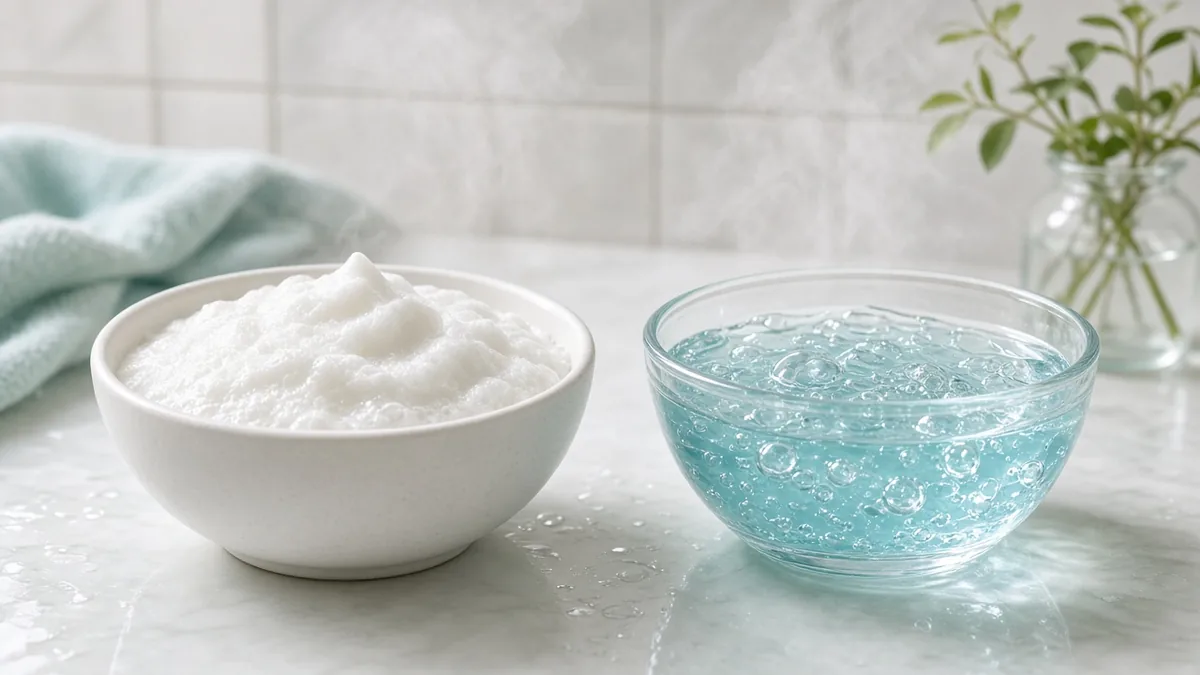
- Texture is the most visible difference. Shower gels are often gel-like, while body washes can range from clear liquids to creamy emulsions.
- More foam does not automatically mean better cleansing. Surfactant chemistry and formula balance matter more than lather volume.
- Dry or sensitive skin usually benefits from a gentler cleansing system. Fragrance level and after-wash tightness also matter.
- The label name does not reveal the surfactant system. Two products called “body wash” can be more different than a body wash and a shower gel.
What is the real difference?
Body wash is a rinse-off liquid body cleanser that can range from clear and fluid to creamy and conditioning.
Shower gel is a rinse-off body cleanser usually presented with a more gel-like texture and a fresh, high-foam sensory profile.
Surfactant is a cleansing ingredient with water-loving and oil-loving portions that helps remove oil, sweat, and soil from the skin surface.
These definitions describe common product conventions, not fixed formulas.
A brand can call a clear gel product “body wash.” Another can use “shower gel” for a formula with moisturizing ingredients.
The U.S. FDA does not organize cleanser regulation around a technical body-wash-versus-shower-gel distinction. It looks at composition and intended use when determining whether a cleanser is soap, a cosmetic, or another regulated product category.
For example, FDA explains:
“Most body cleansers, both liquid and solid, are synthetic detergent products.”
That is why the formula is a more useful technical signal than the front-label category name.
For product development, “body wash” and “shower gel” are best treated as sensory and positioning briefs. They are not complete surfactant specifications.
| Feature | Body wash | Shower gel |
|---|---|---|
| Typical texture | Clear liquid, gel, creamy wash, or emulsion | Often clear to translucent and gel-like |
| Typical sensory position | Comfort, moisture support, daily cleansing | Freshness, fragrance, lather, refreshing cleanse |
| Foam | Low to high depending on surfactants | Often positioned for more visible lather |
| Conditioning ingredients | Common in many formulas | Can be present; not excluded by the format |
| Fragrance | Low to high | Often more fragrance-forward |
| Dry-skin fit | Often easier to formulate toward mildness and conditioning | Depends entirely on surfactants and full formula |
| Oily-skin fit | Can work well | Can work well |
| Technical rule | No single required surfactant system | No single required surfactant system |
How do they compare at a glance?
These are market and formulation tendencies, not universal rules.
A shower gel can be mild and conditioning.
A body wash can also be strongly cleansing or highly fragranced.
What actually cleans the skin?
Surfactants do the main cleansing work in most liquid body cleansers.
Skin carries sebum, sweat residues, sunscreen, environmental particles, and other materials that water alone may not remove well.
Surfactants help surround oily material and disperse it into the rinse water.
A peer-reviewed review explains that surfactant-containing cleansers can break down and emulsify many skin impurities so they can be removed during rinsing: Skin Cleansing without or with Compromise: Soaps and Syndets.
Common surfactant families used in rinse-off cosmetics include:
- anionic surfactants
- amphoteric surfactants
- nonionic surfactants
- cationic surfactants in more specialized systems
The ingredient family alone does not tell you whether a cleanser is mild.
Formulators often combine surfactants to balance cleansing, foam, viscosity, rinse feel, and skin compatibility.
If you are weighing a cleanser against an exfoliating scrub rather than against another cleanser, see body scrub vs body wash.
[FORMULATION NOTE] A cleanser should not be judged from one surfactant name alone. Blend design, total system, pH, polymers, lipids, and rinse-off behavior all affect mildness.
Does more foam mean better cleansing?
No. Foam is mainly a sensory signal, not a direct measurement of cleansing performance.
Consumers often associate rich lather with effective cleansing.
Some surfactants also naturally create more visible foam than others.
But a low-foam formula can still remove oil and dirt effectively.
Likewise, a high-foam product can feel drying if the cleansing system removes too much surface lipid or leaves skin feeling tight.
The American Academy of Dermatology advises people with dry skin to use a gentle cleanser and avoid using so much cleanser that they create a thick lather: AAD — Dermatologists’ top tips for relieving dry skin.
For product selection, after-wash comfort is more useful than foam volume alone.
Which is better for dry skin?
Choose the gentler finished cleanser rather than choosing by the words body wash or shower gel.
Dry skin usually benefits from a formula that cleans without leaving a tight or rough after-feel.
Useful features may include:
- a mild surfactant blend
- lower fragrance exposure
- glycerin or other humectants
- emollient or conditioning ingredients
- a skin-compatible pH
- easy rinse-off
- directions that do not encourage excessive washing
AAD recommends gentle, fragrance-free products for dry and sensitive skin.
It also advises limiting shower time and using warm rather than hot water.
A creamy body wash may make those goals easier to communicate.
However, a well-formulated shower gel can also be mild.
The product name is not enough to decide.
Which is better for oily or sweaty skin?
Either format can work. The cleansing system and user preference matter more than the label.
Someone who sweats heavily may prefer:
- a fresh-rinsing cleanser
- stronger sensory foam
- a gel texture
- a more noticeable fragrance
- a formula that removes sunscreen or body-care residue easily
That is one reason shower gels are often positioned around freshness and post-workout use.
But oily skin does not require the harshest cleanser available.
Over-cleansing can leave skin uncomfortable, especially when frequent showers, hot water, or strong fragrance are added to the routine.
A body wash with a balanced surfactant system can clean oily or sweaty skin just as effectively for everyday use.
What about sensitive skin?
Sensitive skin should prioritize formula simplicity and tolerability over product format.
Look for:
- fragrance-free positioning when appropriate
- a mild surfactant system
- low after-wash tightness
- minimal unnecessary sensory additives
- clear use directions
- a formula designed for frequent body cleansing
DermNet notes that synthetic detergent cleansers, or syndets, can be formulated closer to normal skin pH and may cause less dryness than traditional soap: DermNet — Soaps and Cleansers.
That does not mean every syndet is automatically mild.
The same DermNet guidance notes that even products marketed as hypoallergenic can still irritate very sensitive skin.
Persistent irritation, eczema, or another diagnosed skin condition may require guidance from a healthcare professional rather than trial-and-error product switching.
Is shower gel stronger than body wash?
Not as a universal rule.
“Shower gel” often suggests a clear gel, visible lather, and fresh cleansing experience.
That positioning can lead brands to choose a more cleansing-forward surfactant balance.
But nothing about the word gel proves a higher surfactant level or greater cleansing strength.
A body wash can also be formulated for strong cleansing.
A shower gel can be built around mild surfactants.
The better technical questions are:
- Which surfactants are used?
- How are they blended?
- What is the finished pH?
- Does the product include conditioning ingredients?
- How does the skin feel after rinsing?
- How often is the product intended to be used?
Those questions tell you more than the category name.
Does pH matter?
Yes. pH is one part of cleanser mildness, although it is not the only factor.
Traditional alkaline soap can raise skin-surface pH and contribute to dryness or irritation in some users.
Synthetic detergent systems provide more flexibility.
DermNet notes that syndets can be adjusted closer to normal skin pH and are generally less drying than traditional soap.
The peer-reviewed cleanser review also describes pH, surfactant composition, rinsability, and skin compatibility as important parts of cleanser design.
A skin-compatible pH does not automatically make a harsh surfactant system gentle.
Likewise, pH alone cannot predict the complete user experience.
Is body wash the same as soap?
Not necessarily. Most bottled body washes are not “true soap” in the regulatory or chemical sense.
Syndet is a synthetic-detergent cleansing system that uses surfactants rather than relying on alkali salts of fatty acids for cleansing.
FDA defines true soap narrowly.
To meet its regulatory definition, the main nonvolatile material must be alkali salts of fatty acids. Those compounds must also provide the product’s cleansing action.
FDA explains that many modern liquid and solid body cleansers instead use synthetic detergents.
A product can still use the word “soap” in consumer-facing language while falling into a different regulatory category depending on composition and intended use.
See FDA — Is It a Cosmetic, a Drug, or Both? (Or Is It Soap?).
For ordinary body-wash selection, the practical lesson is simple:
Do not assume “soap,” “body wash,” and “shower gel” reveal the chemistry by themselves.
Does fragrance matter?
Yes, especially for sensitive or dry skin.
Fragrance can be an important part of the shower experience.
It can also be unnecessary exposure for people who react to fragranced products.
Shower gels are often marketed with stronger fragrance stories because the format is frequently positioned around freshness and sensory experience.
Body washes can be equally fragranced.
The choice again belongs to the finished formula.
AAD recommends fragrance-free skin-care products for dry, sensitive skin.
It also distinguishes “fragrance-free” from “unscented,” because an unscented product may still contain ingredients used to mask odor.
What ingredients make a cleanser feel more conditioning?
Conditioning comes from the complete rinse-off system, not from calling the product a body wash.
Formula approaches may include:
- glycerin or other humectants
- emollient materials
- refatting agents
- conditioning polymers
- lipid or oil components
- surfactant blends selected for lower harshness
- rheology systems that improve slip
- ingredients that reduce a stripped after-feel
Some of these materials rinse away substantially.
Others can affect the sensory feel during and after cleansing.
A formula still needs to remain stable, preserve properly, rinse cleanly, and deliver acceptable foam.
For the broader relationship between ingredients, texture, and product performance, see cosmetic formulation.
Does thicker gel mean stronger cleansing?
No. Viscosity and cleansing strength are separate formulation variables.
A thick shower gel can be created through:
- salt response in a surfactant system
- polymeric thickeners
- gums
- surfactant structuring
- other rheology approaches
A very thick gel may use a mild surfactant blend.
A thin body wash may use a stronger cleansing system.
Thickness mainly changes dispensing, suspension, visual appearance, and sensory feel.
It should not be used as a shortcut for judging surfactant strength.
Which is better in hot or humid weather?
Many people prefer shower-gel textures in hot weather because they feel fresh and rinse quickly.
That is a sensory preference, not a technical requirement.
A lightweight body wash can provide the same kind of experience.
Humid weather may reduce the appeal of heavy conditioning films.
Dry or air-conditioned environments may make a milder, more conditioning cleanser feel better.
Climate should therefore guide sensory balance, not dictate the product name.
How should a brand or buyer compare formulas?
Compare the cleansing system before comparing the category label.
A useful evaluation sequence is:
- Define the target skin feel.
- Decide how much foam matters to the user experience.
- Review the surfactant blend.
- Check fragrance direction.
- Review conditioning ingredients.
- Evaluate viscosity and dispensing.
- Confirm pH and formula stability.
- Test rinse behavior and after-wash feel.
- Match packaging to viscosity.
- Keep claims within the intended cosmetic use.
This separates product development from naming.
A brand can then choose body wash or shower gel based on positioning after the formula direction is clear.
Quick decision guide
Choose a body wash first when:
- you prefer a creamy or conditioning cleanse
- your skin tends to feel dry after showering
- you want a broader range of texture options
- fragrance is secondary to skin comfort
- you use the cleanser frequently
- you want a daily family-style body cleanser
Body wash is often the easier label for comfort-focused positioning.
Choose a shower gel first when:
- you prefer a clear gel texture
- visible foam is important to the sensory experience
- you want a fresh-rinsing feel
- fragrance is a central part of the concept
- the product targets post-workout or refreshing use
- gel aesthetics fit the packaging and brand
Shower gel is often the easier label for freshness-focused positioning.
Neither list overrides the actual formula.
Buyer checklist
Compare these points before choosing or developing either format:
- Surfactant system
- After-wash tightness or comfort
- Foam level and foam quality
- Finished pH
- Fragrance level
- Humectants and conditioning ingredients
- Clear, gel, creamy, or emulsion texture
- Viscosity and pump compatibility
- Rinse speed and residue
- Intended frequency of use
- Dry, normal, oily, or sensitive-skin positioning
- Preservation and finished-product stability
- Cosmetic claims and target market
Brands comparing broader body-care formats can review the body care category.
For bulk formula families, see bulk cosmetic bases.
FAQ
Are body wash and shower gel the same?
They serve the same basic purpose: cleansing the body during bathing or showering. The names often signal different texture and sensory positioning, but there is no universal formula that separates every body wash from every shower gel.
Is shower gel more drying?
Not automatically. Some shower gels are cleansing-forward and highly fragranced, while others use mild surfactant systems. Dryness depends on the complete formula and how the product is used.
Is body wash better for sensitive skin?
It can be, especially when the product is fragrance-free and built around mild surfactants. A shower gel can also be formulated for sensitive skin. Read the formula and positioning rather than relying only on the name.
Which makes more foam?
Shower gels are often positioned for visible lather, but foam depends on surfactants and formula design. The name on the package does not guarantee more foam.
Does more foam clean better?
No. Foam contributes strongly to the cleansing experience, but it is not a direct measure of how effectively or gently a product removes oil and dirt.
Can shower gel contain moisturizing ingredients?
Yes. Glycerin, conditioning polymers, emollients, and other skin-feel ingredients can be used in shower gels. They are not exclusive to body washes.
Is body wash soap?
Usually not in the strict regulatory sense. FDA notes that most modern body cleansers are synthetic detergent products rather than true soap.
Is shower gel good after exercise?
It can be. A fresh-rinsing gel can feel pleasant after sweating, but a body wash can perform the same cleansing job when its surfactant system is appropriate.
Which should I choose for dry skin?
Start with the gentler formula. Look for mild surfactants, lower fragrance exposure, a comfortable after-feel, and directions suited to frequent use.
Sources
- U.S. FDA — Frequently Asked Questions on Soap
- U.S. FDA — Is It a Cosmetic, a Drug, or Both? (Or Is It Soap?)
- American Academy of Dermatology — Dermatologists’ top tips for relieving dry skin
- PMC — Skin Cleansing without or with Compromise: Soaps and Syndets
- DermNet — Soaps and Cleansers
Related reading
Related reading: body wash vs bar soap body wash vs hand soap body wash vs shampoo.