Key takeaways
- Ingredient names help you compare labels without relying only on front-of-pack claims.
- Order offers clues about relative amounts, but it does not reveal every percentage.
- A short list is not automatically better, and an unfamiliar name is not a warning by itself.
- An ingredient database can explain a name or function. It cannot confirm how a finished product will perform for you.
What do the ingredient names actually mean?
The names identify materials; they do not describe the whole experience of using a product. A recognizable marketing phrase such as “vitamin-rich cream” tells you less about its composition than the ingredient declaration does.
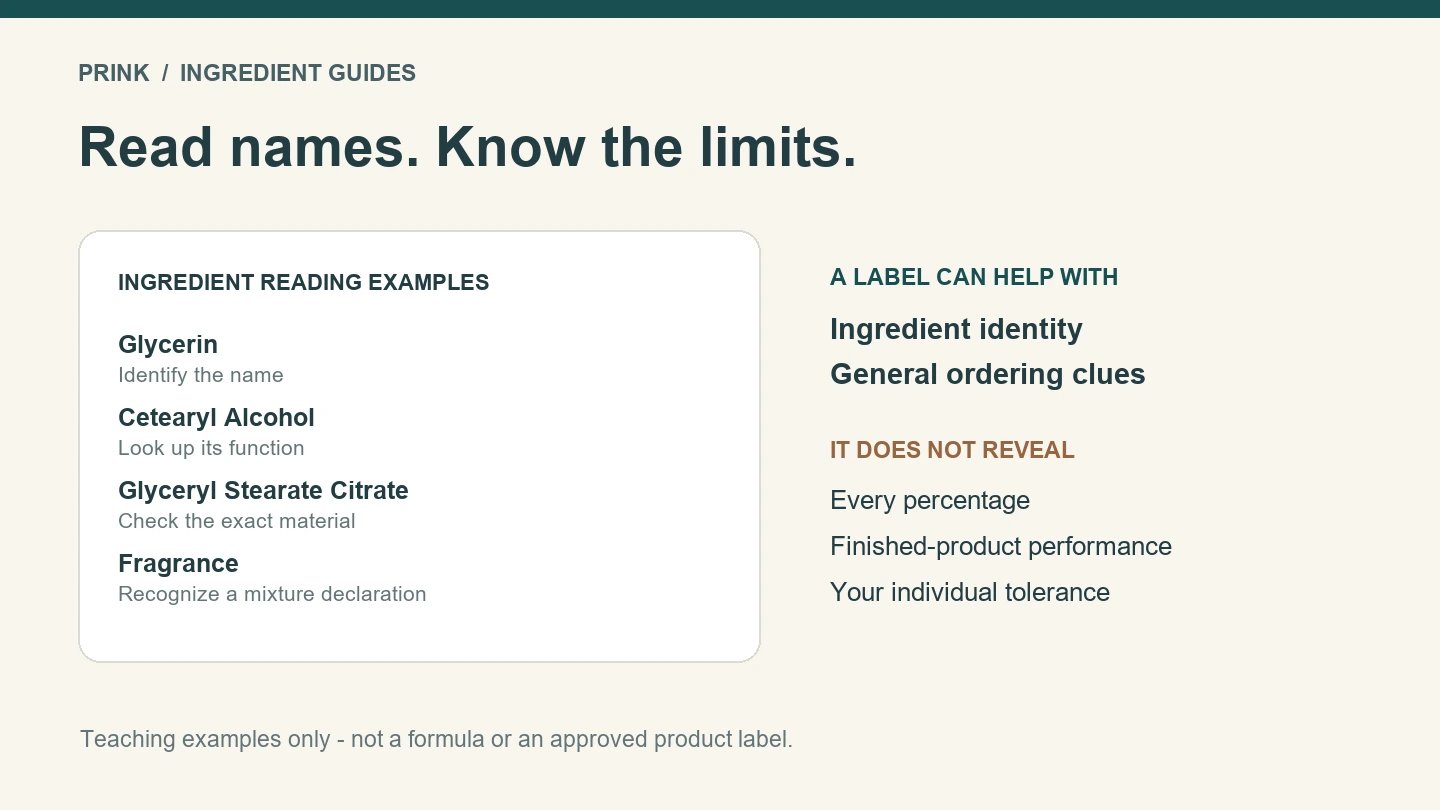
You might recognize glycerin but need to look up a longer name. That difference in familiarity does not rank the two ingredients by quality or safety. Botanical names, chemical names, and familiar names can all appear in cosmetic ingredient information.
Also distinguish the name of a raw material from a supplier's trade name. A branded ingredient can be a blend of several components. Reading its promotional name does not tell you which individual names belong on a finished-product label.
Keep the target market in mind. The FDA Cosmetics Labeling Guide explains U.S. naming requirements. Do not assume that copying an international ingredient database entry produces a compliant label everywhere. This article explains how to read ingredient information; the broader guide to cosmetic labeling requirements covers the separate packaging task.
How much can ingredient order tell you?
For U.S. cosmetics, the general rule is descending predominance, with exceptions. That makes order useful, but less precise than a recipe.
“The ingredients must be declared in descending order of predominance.” — U.S. Food and Drug Administration
The same FDA guide explains that ingredients at 1% or less may appear in any order after those above 1%. Color additives have separate ordering provisions. Products that are also drugs need additional care when reading active and other ingredient information.
Three practical consequences follow:
- Do not read the label as a percentage chart. Position alone does not tell you an exact amount.
- Do not draw a visible “1% line” without formula information. The label does not mark where that group begins.
- Do not equate a low position with no useful role. An ingredient's purpose is a different question from its proportion.
For example, suppose two labels put glycerin in different positions. That observation can prompt a question, but it cannot establish the percentage difference or prove which finished product moisturizes better. You would need more information about both formulas and appropriate performance evidence.
How can you group ingredients without decoding every name?
Start by asking what kind of job a material might do. This is a reading aid, not a way to reconstruct a formula.
| Example name | A useful function to look up | What the name does not establish |
|---|---|---|
| Glycerin | Humectant: helps a formula hold moisture | Its percentage or the product's measured moisturizing effect |
| Caprylic/Capric Triglyceride | Emollient: contributes to softness and feel | Whether the whole formula will feel light or rich |
| Cetearyl Alcohol | Fatty alcohol used for texture and related functions | That it behaves like a volatile alcohol solvent |
| Glyceryl Stearate Citrate | Emulsifying function in suitable systems | That it can stabilize any oil-and-water combination |
| Fragrance | Fragrance mixture declaration | The complete identity of every component of that mixture |
These are separate teaching examples, not a complete ingredient declaration, tested formula, or approved label. A material may have more than one function. Check the exact name and supplier information before applying an interpretation to a real product.
For cream and lotion labels, it also helps to understand the difference between dispersed oil and the surrounding water phase. Our oil-in-water emulsion examples explain that structure without turning an ingredient list into a manufacturing recipe.
Why might a fragrance mixture appear under one name?
A label may provide less detail about a fragrance mixture than you expect. The FDA's Fragrances in Cosmetics page explains the use of “fragrance” in ingredient labeling.
Do not assume that the absence of individually named fragrance components proves their absence from the mixture. If you need to avoid a particular substance, the ingredient declaration may leave a question for the manufacturer.
Front-of-pack wording deserves a separate check too. Our guide to fragrance-free versus unscented labels explains why those descriptions need more care than simply checking whether a product has an obvious scent.
What can an ingredient database confirm?
It can help you identify a name and find useful references. It cannot approve a finished product on your behalf.
The European Commission's CosIng information page describes the database and its limits. In particular, an ingredient's appearance in the inventory does not itself mean it is approved for cosmetic use. Regulatory status depends on the applicable rules and conditions.
A sensible lookup sequence is:
- Copy the exact ingredient name from the product, including any numbers or modifiers.
- Check a recognized reference and confirm that you are reading the same substance or material.
- Separate a listed function from a claim about the finished product.
- Check market-specific restrictions when making a labeling or formulation decision.
Avoid turning one database score into a verdict on the entire product. A name lookup cannot replace information about the formula, intended use, or supporting assessment.
What does a label leave unanswered?
It leaves important questions about formulation and finished-product performance. Treat those gaps as limits of the evidence, not an invitation to guess.
| Question | Can the ingredient declaration alone answer it? |
|---|---|
| Does this name appear on the label? | Usually, subject to the relevant declaration rules and exceptions |
| What is the exact percentage? | Generally no |
| What are the finished product's pH and texture? | No |
| Has this exact product passed a particular test? | No |
| Will two products with similar lists feel identical? | No |
| Will I tolerate the product? | The list alone cannot establish that |
For brand teams, a useful distinction is ingredient identity versus supporting documentation. In Prink's authorized VN-HCM-09 raw-material supply case, the recorded evidence included INCI information, specifications, COA, SDS/MSDS, test reports, and batch records. Those are distinct records, not interchangeable names for the same assurance. The case illustrates document matching; it does not establish a particular finished product's performance or labeling compliance.
A quick checklist for your next comparison
Choose two products meant for the same kind of use. Comparing unlike products can make ingredient differences look more informative than they are.
- Read the ingredient declarations rather than comparing only the advertised hero ingredients.
- Look up unfamiliar names without assuming that longer means harsher or more sophisticated.
- Note the general ordering, while respecting the exceptions.
- Check any ingredients you already know you need to avoid.
- Write down questions the labels cannot resolve instead of estimating percentages.
- For a commercial decision, match the current ingredient information to the actual formula version and target market.
The most useful outcome is a clearer set of questions. You do not need to identify every ingredient's chemistry to recognize when a label supports a comparison and when it does not.
Frequently asked questions
Is INCI the same as the ingredient list?
INCI is a naming system; an ingredient list is the declaration you read on a product. People often use the phrase “INCI list” for that declaration, but naming and labeling requirements still need to be checked for the market involved.
Can I work out a formula from the label?
No. Order does not reveal all concentrations, and the declaration does not provide the manufacturing method or a finished-product specification. A similar list is not proof of an identical formula.
Is a shorter ingredient list always better?
No. Length alone does not tell you whether the product is suitable, effective, or well formulated. Compare the product's purpose, your needs, and the evidence available.
Does a CosIng entry mean an ingredient is approved?
No. The European Commission explicitly distinguishes inventory information from permission to use an ingredient. Check the applicable conditions rather than treating a search result as approval.
For the ingredient-sourcing side of this topic, explore the cosmetic ingredients and raw materials collection. This guide provides general label-reading education, not an assessment of a specific formula or package.