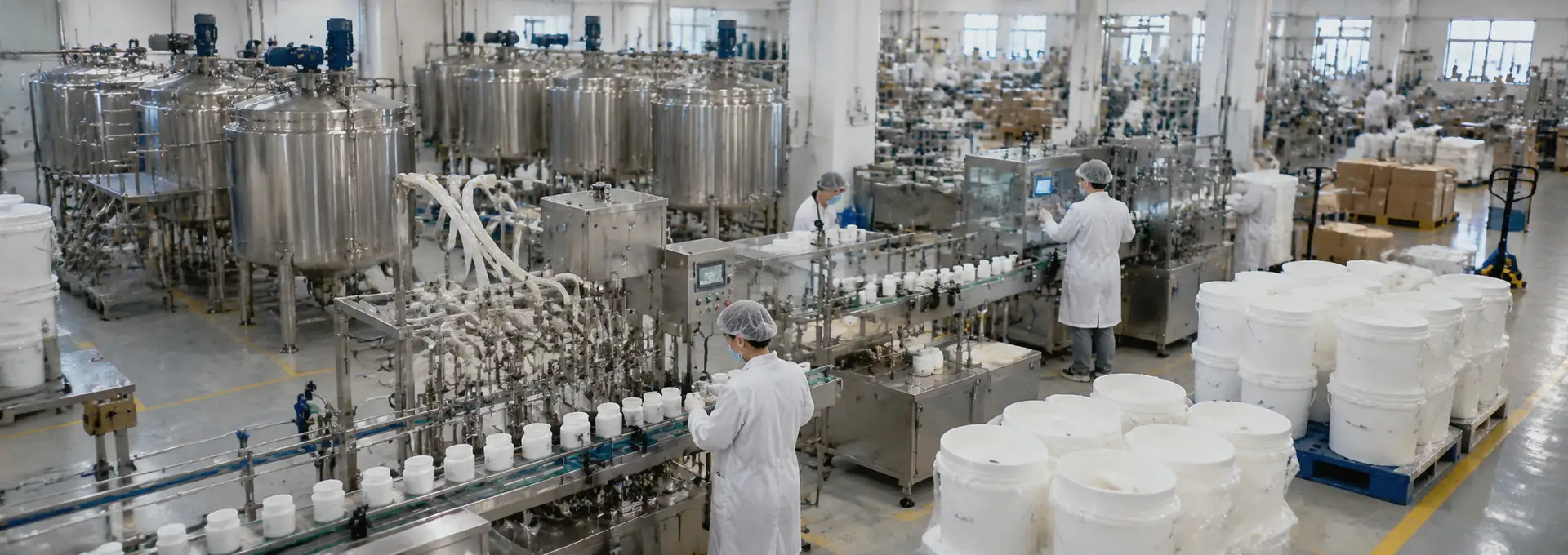
The cosmetic manufacturing process turns an approved formula into a traceable, consistent, and releasable batch. It includes much more than mixing: materials must be received and identified, quantities must be weighed against controlled instructions, process conditions must be recorded, the bulk must be checked, packaging must be prepared, and quality staff must review the evidence before the batch is released.
The exact equipment and settings change with the formula, scale, factory, and package. The control logic is more consistent: know what should happen, record what did happen, investigate meaningful differences, and release only when the batch meets its approved requirements.
Key takeaways
- Production should begin from an approved formula, specifications, packaging information, and manufacturing instructions.
- Raw-material identity, lot status, weighing, and traceability are control points—not warehouse paperwork.
- Addition order, temperature, shear, mixing time, vacuum, and cooling can change texture and uniformity.
- Filling is part of manufacturing because the package and fill system can affect product quality.
- A finished-looking unit is not automatically a released unit; quality review and batch disposition come last.
| Stage | Main question | Typical evidence |
|---|---|---|
| Production setup | Are the formula, instructions, specifications, and equipment ready? | Approved master instruction, line clearance, equipment status |
| Material control | Are the correct lots identified, released, and weighed? | Material labels, lot numbers, weigh tickets |
| Compounding | Was the approved sequence followed under controlled conditions? | Batch record, time/temperature entries, operator checks |
| In-process control | Does the bulk match defined checkpoints? | Appearance, pH, viscosity, weight, or other formula-specific checks |
| Filling and packing | Is the right bulk going into the right components and codes? | Component reconciliation, fill checks, line records |
| Release | Does the batch meet specifications and documentation requirements? | QC results, deviation review, release approval |
What happens before a production batch starts?
A production team needs a controlled starting point. That normally includes an approved formula, raw-material specifications, target bulk specifications, packaging components, manufacturing instructions, sampling requirements, and a defined release pathway.
This stage is different from product development. During cosmetic formulation, the team may still be changing ingredient levels, processing order, sensory targets, or packaging options. Production begins after the relevant version is approved for the intended batch.
The master manufacturing instruction should identify the formula version and describe the required sequence. It may also specify equipment type, batch size, addition phases, mixing controls, sampling points, and precautions. Operators then create a batch-specific record showing what was actually used and done.
The distinction matters because a good formula can still fail in execution if an old version is used, a material is substituted without review, equipment is not suitable for the scale, or a required step is skipped.
The U.S. Food and Drug Administration connects this control mindset directly to product risk:
“Rigorous adherence to good manufacturing practice minimizes the risk of adulteration or misbranding of cosmetics.” — U.S. Food and Drug Administration
That sentence does not prescribe one universal process. It explains why documented controls matter.
How are raw materials received, checked, and weighed?
Raw materials should be linked to an identity, supplier, lot number, receipt record, and status. A factory needs a way to distinguish material that is awaiting review from material that is released, rejected, expired, or otherwise restricted.
Receiving controls may include packaging inspection, label review, quantity confirmation, storage-condition checks, and verification against purchasing or specification records. The required testing or documentation depends on the material and the factory’s control program.
When materials are dispensed for a batch, the operator should be able to answer four questions:
- Is this the correct material?
- Is this lot approved for use?
- Was the correct quantity weighed with suitable equipment?
- Can this quantity be traced back to both the source lot and the finished batch?
Weighing errors are not always dramatic. A misplaced decimal, a tare mistake, a unit conversion, or a second similar-looking ingredient can change a batch. Independent checks, barcode systems, controlled labels, or electronic verification may be used depending on the facility and risk.
After weighing, containers should remain clearly identified. Unlabeled bowls and temporary vessels create a preventable traceability gap.
What happens during compounding and homogenization?
Compounding is the controlled combination of materials. The process may include separate water and oil phases, powder wetting, heating, emulsification, neutralization, cooling, fragrance addition, preservative addition, color adjustment, or deaeration. Not every product uses every step.
The important variables are formula-specific:
- Addition order: Some materials need pre-dispersion, hydration, or a particular phase.
- Temperature: Heating may support melting or emulsification, while heat-sensitive materials may be added later.
- Shear: High shear can improve dispersion or droplet reduction, but excessive shear can damage certain structures or entrain air.
- Mixing time: Too little may leave nonuniform areas; too much can add heat, air, or unnecessary processing.
- Cooling profile: Cooling can influence viscosity, crystallization, and final texture.
- Vacuum or deaeration: Air removal may improve appearance, filling consistency, and density control.
This is why a process cannot be copied from a small beaker to a larger vessel by multiplying every number. Vessel geometry, impeller design, batch depth, heat transfer, and pumping behavior change with scale.
ISO describes ISO 22716 as GMP guidance covering the production, control, storage, and shipment of cosmetic products. The scope is a useful reminder that manufacturing controls extend beyond the moment ingredients meet.
Factory note: In production work, the formula, vessel, batch size, and package are reviewed as one system. A packaging change can justify trial filling or compatibility work even when the ingredient list has not changed.
An anonymized new-product project, recorded internally as VN-HCM-05, moved through requirement analysis, formulation, sampling, packaging, manufacturing, and documentation with stage approvals. The useful lesson is the handoff discipline—not an invented promise that every project follows the same timing.
Which checks happen while the batch is still in the vessel?
In-process controls help the team decide whether the batch is ready for the next step. The selected checks should match the formula and the approved process.
Common examples include:
- appearance, color, and odor;
- pH, when relevant;
- viscosity or flow behavior;
- temperature;
- density or specific gravity;
- batch weight or yield;
- uniformity or absence of visible undispersed material.
These checks are not substitutes for all finished-product testing. They are checkpoints that may reveal a mixing, weighing, temperature, or sequence issue while the material is still in a controllable state.
If a result falls outside an approved range, the response should follow a defined deviation or adjustment process. That may involve confirming the measurement, reviewing the batch record, checking calculations, assessing whether an approved adjustment is allowed, and documenting the decision. Quietly “fixing” a batch without traceable review weakens the entire record.
For a broader view of stability, microbiology, packaging, safety, and claims support, see the guide to cosmetic product testing.
How do filling, packaging, and coding fit into production?
Before filling, the bulk may need a hold-time review, transfer, filtration, deaeration, or gentle remixing. The line and components should be cleared for the correct product, size, and packaging version.
During filling, teams may monitor:
- fill weight or volume;
- closure fit or torque;
- seal quality;
- leakage;
- pump or spray function;
- container cleanliness;
- coding and legibility;
- label or carton version;
- unit and component reconciliation.
Packaging is not merely decoration. A formula can interact with a pump, gasket, liner, tube, jar, or coating. Viscosity can affect fill accuracy and dispensing. A volatile component can change package performance. A light-sensitive formula may need protective packaging.
The finished label must also match the approved market information. The article on cosmetic labeling requirements explains the U.S. basics and why identity, net quantity, ingredient information, and responsible business details need controlled review.
What must happen before a batch can be released?
Batch release is a documented decision. The reviewer needs the required test results, completed manufacturing and packaging records, reconciliation information, and any deviation or investigation outcomes.
The release package varies by product and market, but the review often asks:
- Were the approved formula and packaging versions used?
- Were all required materials released and traceable?
- Were critical process steps and checks completed?
- Do finished-product results meet the specification?
- Were deviations assessed and closed appropriately?
- Are codes, labels, and quantities correct?
- Is the batch approved for shipment, rejected, or placed on hold?
In the United States, the Modernization of Cosmetics Regulation Act of 2022 added important requirements including facility registration, product listing, and safety substantiation duties. These obligations provide regulatory context, but they do not turn a facility registration into product approval.
Other markets have their own responsible-person, safety-file, notification, labeling, and language requirements. Release planning should therefore begin with the target market, not after the batch is packed.
Use this process checklist to review a production plan
- [ ] The formula, specifications, packaging, and manufacturing instruction are approved and version-controlled.
- [ ] Equipment status, cleanliness, and line clearance are documented.
- [ ] Raw materials are identified, within status, and traceable by lot.
- [ ] Weighing records show material, quantity, equipment, and checks.
- [ ] Addition order and key process conditions are recorded.
- [ ] Required in-process checks are completed and reviewed.
- [ ] Any adjustment or deviation follows an approved path.
- [ ] Filling components, codes, and label versions are reconciled.
- [ ] Finished-product results meet the approved specification.
- [ ] Quality review documents the final batch disposition.
Common questions
Is cosmetic manufacturing the same as formulation?
No. Formulation develops and approves what the product should be. Manufacturing executes an approved version at a defined scale and records the batch. The two functions interact, especially during scale-up and process transfer, but they are not interchangeable.
Does every cosmetic need the same production controls?
No. A water-thin cleanser, an emulsion, an anhydrous balm, and a powder have different process risks. Controls should reflect the formula, equipment, batch size, packaging, and target market.
Can a batch be shipped as soon as it is filled?
Not automatically. Required checks, records, and release review need to be complete. Some products may also have defined hold, test, or documentation requirements before shipment.
Where does manufacturing sit in a product launch?
It follows development approval and sits before market release and distribution. If you are mapping the full project, the guide to starting a beauty brand provides the broader sequence.