
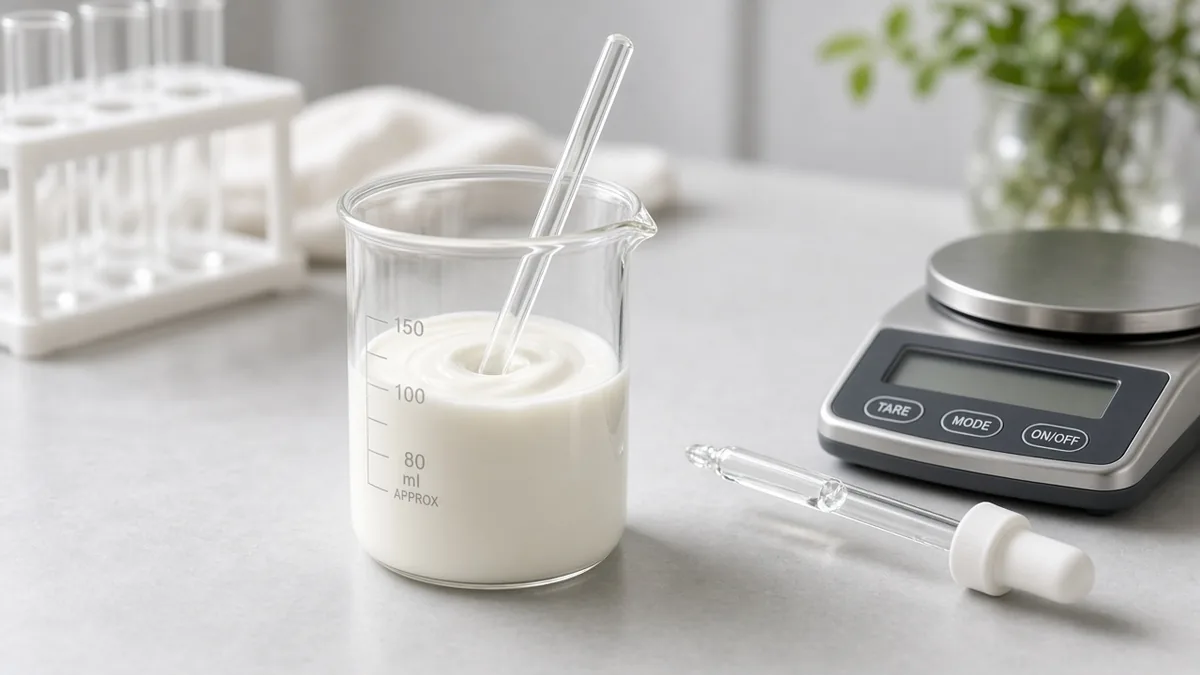
Key takeaways
- Decide which phase is continuous before choosing an emulsifier or a process.
- Emulsifier, oil composition, thickener, droplet size, and mixing history interact; no single ratio guarantees stability.
- Record the pilot's actual processing conditions and compare it across relevant storage conditions.
- Physical stability and microbiological protection are separate questions, especially in water-containing products.
Which phase should be continuous?
An oil-in-water (O/W) emulsion has oil droplets dispersed in a continuous water phase. It often suits a lighter lotion feel and may be easier to rinse from skin. A water-in-oil (W/O) emulsion has water droplets dispersed in a continuous oil phase and can feel richer or more water-resistant. Those are design tendencies, not promises about every formula.
Choose by intended use: application area, desired spread and after-feel, packaging, and the ingredients that must be carried. The existing oil-in-water emulsion examples show product formats; this guide focuses on how to design and assess the underlying system. A very rich O/W cream and a light W/O emulsion are both possible, so phase label alone does not determine user experience.
How do you set the oil phase and emulsifier system?
List the functions first: emollience, structure, glide, active delivery if relevant, and sensory finish. Then choose oils and other materials that fit those functions and a compatible emulsifier system. Consider the emulsifier supplier's guidance, required use range, processing temperature, and suitability for the chosen phase type. A thickener can slow visible separation but cannot rescue a fundamentally incompatible system.
For a pilot, hold total mass constant and change one design variable at a time. Compare emulsifier level, oil type, or mixing method separately. Record pH where relevant, viscosity, appearance, and the direction of any change after storage. Avoid claiming that one HLB number or one “ideal” emulsifier percentage will work across every oil blend.
A published emulsion study indexed by PubMed varied ultrasound treatment time, oil content, and oleic-acid content in one oil-in-water system and measured changes in its stability. Its value here is methodological: stability was assessed for a particular system. Its numeric optimum should not be copied as a rule for unrelated ingredients or mixing processes.
What process variables change the result?
Heating, addition order, shear, mixing time, and cooling can change droplet formation and final texture. Work from the actual raw-material instructions. Prepare the phases consistently, combine them in the order specified for the selected system, and record temperature and mixing conditions. During cooling, watch for viscosity development and add heat-sensitive materials only in their allowed conditions.
A reproducible record identifies every ingredient and lot, its mass, the vessel and mixer, the order of addition, the heating and cooling history, and sample dates. That record is what lets you tell whether a stability change came from a formula adjustment or a process change. Do not report a viscosity or droplet-size improvement unless it was actually measured.
For example, use a controlled pilot matrix rather than changing the oil, emulsifier, and mixer at once:
| Pilot | Keep constant | Change | Question answered |
|---|---|---|---|
| A: baseline | Recorded materials and process | Nothing | What does the starting system do? |
| B: emulsifier check | A's oil blend and process | One emulsifier level within supplier guidance | Did that change alter the measured result? |
| C: process check | A's exact formula and materials | One mixing condition | Was the result process-sensitive? |
Compare B and C separately with A after the same storage conditions. Decide in advance which observations would count as a failure, such as visible separation, unacceptable viscosity drift, or package incompatibility. This table is an experiment design, not a tested recipe or a claim that any pilot will pass.
How do you screen physical and microbial stability?
Physical checks can include appearance, phase separation, viscosity or flow, odor, color, pH where appropriate, and package interaction over time and across conditions relevant to distribution. A quick centrifuge or heat exposure can reveal weaknesses, but it does not prove a shelf life. Use a controlled, documented stability plan for the final intended product.
Water-containing emulsions also need a microbial-control plan. The FDA's product-testing guidance puts the responsibility on the finished product:
“Cosmetics are required to be safe” under labeled or ordinary use. — U.S. FDA
The FDA GMP checklist describes controls for incoming materials, batches, sanitation, and laboratory work. It is guidance and does not prescribe a one-size-fits-all preservative. A preservative selected from an INCI list still needs compatibility and efficacy assessment in the complete emulsion and package.
What should you record before scale-up?
Write down the formula version, process settings, observations, failures, and the test method used to judge each change. Confirm that the prototype remains acceptable in the intended package. Review safety, preservation, and any claim evidence on the final version, not on an earlier sample. When scale changes, the same nominal formula may experience different shear and cooling, so verify the larger batch rather than assuming equivalence.
An authorized Prink cosmetics ingredient-application training case, CA-QC-10, used samples and demonstrations to teach ingredient function and compatibility. It was not a stability study of this emulsion. The relevant practice is to make the selection logic visible: identify an ingredient's job, show how it behaves in a sample, and record where the sample fails. That produces a testable next experiment, not a claim that a formula is already stable.