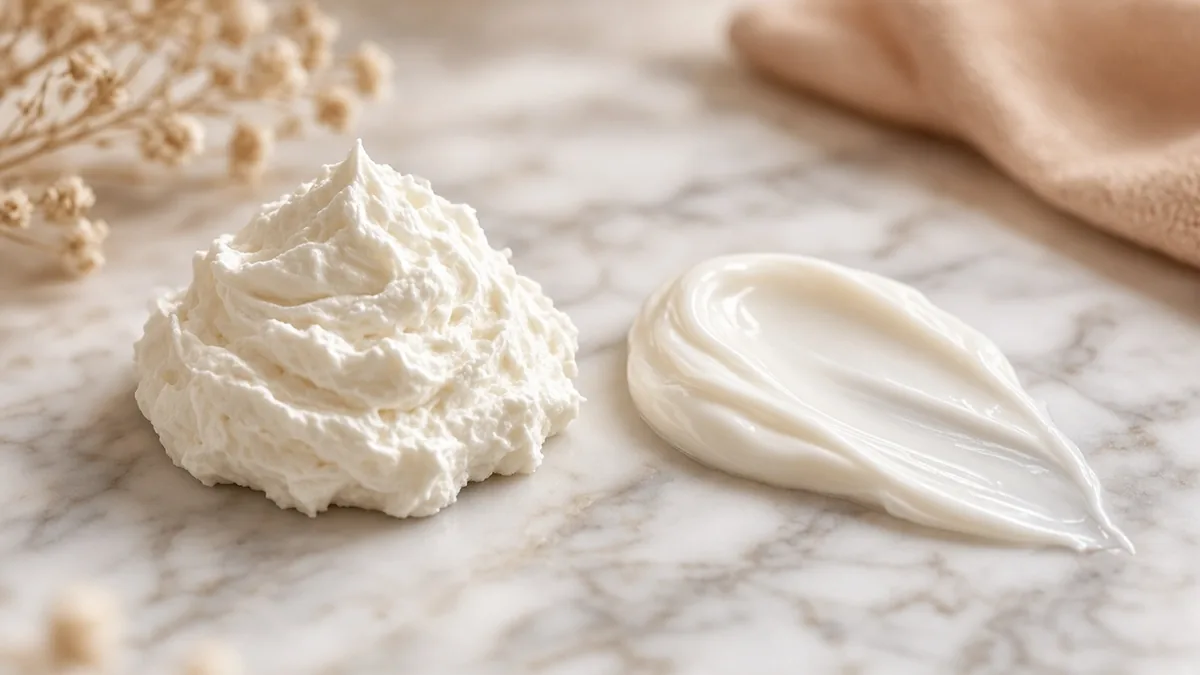
Key Takeaways
- Body butter is usually richer and more occlusive. It often suits dry areas, cold weather, or users who prefer a substantial after-feel.
- Body lotion is usually lighter and easier to spread. It often works well for everyday full-body moisturization.
- The names are not fixed formulas. Some body butters are anhydrous, while others are emulsions; some lotions are richer than expected.
- Texture does not equal performance. Humectants, emollients, occlusives, and the complete formula determine how a product moisturizes.
- Very dry skin may still need a cream or ointment. Body butter is a cosmetic format, not automatically the strongest moisturizer available.
What is the main difference?
Body butter is a rich body-moisturizing format usually built around a high level of lipids, butters, oils, waxes, or a dense emulsion structure.
Body lotion is a fluid leave-on moisturizer that usually contains a water phase and an oil phase held together as an emulsion.
Moisturizer is a product designed to help maintain water in the stratum corneum while improving skin softness and comfort.
The clearest difference is usually texture and sensory richness.
Body butter tends to feel more substantial.
Lotion tends to feel lighter and spreads over large areas more easily.
DermNet lists oils, lotions, creams, gels, and ointments as common moisturizer formats. It also explains that richer formats generally provide more occlusion than lighter ones: DermNet — Emollients and Moisturisers.
“Body butter” is a useful consumer format name, but not a precise technical specification. Formula structure matters more than the category label.
| Feature | Body butter | Body lotion |
|---|---|---|
| Typical texture | Thick, dense, whipped, balm-like, or rich cream | Fluid to medium viscosity |
| Typical sensory feel | Richer, more persistent, often more occlusive | Lighter, faster-spreading |
| Water content | May be anhydrous or water-containing | Usually water-containing |
| Humectants | May be limited in anhydrous formulas | Commonly included |
| Emollients | Usually high | Common |
| Occlusive effect | Often higher | Varies by formula |
| Best use | Dry areas, colder weather, richer body care | Everyday full-body moisturization |
| Packaging | Jar, tub, wide-mouth container, tube | Pump, bottle, tube |
| Technical rule | No fixed formula | No fixed formula |
How do they compare at a glance?
These are general format tendencies, not universal rules.
A body butter can be surprisingly light.
A lotion can also be rich, highly occlusive, or designed for very dry skin.
Is body butter always anhydrous?
No.
Some body butters contain no water and are built from butters, oils, waxes, esters, or other lipophilic materials.
Others are emulsified products.
Those may contain water, humectants, emulsifiers, preservatives, and a large lipid phase while still being marketed as body butter.
That means the phrase body butter does not automatically tell you:
- whether water is present
- whether the formula needs a preservative system
- whether the product is an emulsion
- how much shea butter or another butter it contains
- how occlusive it will feel
- how much water-binding support it provides
For a full explanation of the format itself, see what is body butter.
This article stays focused on choosing between body butter and lotion.
Which is better for dry skin?
Body butter is often the better cosmetic starting point when skin feels clearly dry and you prefer a richer protective layer.
Its dense lipid phase can provide strong emollient feel.
Many formulas also leave a more persistent surface film.
That can be useful on:
- elbows
- knees
- shins
- hands
- heels
- areas that become rough in winter
However, body butter is not automatically the most effective option for severe dryness.
The American Academy of Dermatology recommends creams or ointments rather than lotions when skin is very dry:
“Ointments and creams add more moisture to skin and are more effective than lotions.”
Source: American Academy of Dermatology — Dermatologists’ top tips for relieving dry skin
That guidance is based on moisturizer format and moisture retention, not the marketing term body butter.
A body butter may behave like a rich cream, balm, or oil-based product depending on the formula.
Which is better for normal skin?
Lotion is usually the more practical everyday choice for normal skin.
It spreads quickly.
It usually leaves less residue before dressing.
That makes it convenient for:
- morning use
- warm weather
- large body areas
- people who dislike sticky or greasy finishes
- frequent application after showering
Body butter can still work for normal skin.
Someone may choose it for fragrance, glow, massage, richer sensory feel, or targeted use.
The choice does not need to be based on dryness alone.
Which is better for oily or acne-prone body skin?
Lotion is usually the easier starting point because lighter textures tend to leave less persistent residue.
That does not mean every lotion is ideal.
A rich lotion may still contain heavy occlusive materials.
Likewise, some body butters use fast-spreading esters or lighter butters and may feel less greasy than expected.
For acne-prone areas such as the chest, shoulders, or back, look at the whole formula.
Fragrance, occlusive load, emollient selection, and the final film can all affect user experience.
Persistent body acne should not be managed only by switching moisturizer formats.
Does body butter moisturize better than lotion?
Not automatically.
Body butter often provides more emollient and occlusive feel.
Lotion usually has an advantage in water delivery and humectant flexibility because it contains an aqueous phase.
A lotion can combine:
- water
- glycerin
- hyaluronic acid
- urea
- panthenol
- oils
- esters
- fatty alcohols
- dimethicone
- petrolatum
- ceramides
An anhydrous body butter usually cannot provide the same water phase.
It may instead focus on emollience and moisture retention.
This is why a body butter can feel richer without necessarily being “more hydrating” in every sense.
[FORMULATION NOTE] Moisturization has several mechanisms. Water binding, skin softening, and surface occlusion should not be treated as the same thing.
For a deeper explanation of those mechanisms, see occlusive skincare.
What ingredients matter most?
Look at the moisturizing system, not only at shea butter or another headline ingredient.
Humectants
Humectants help attract and retain water in the stratum corneum.
Common examples include:
- glycerin
- hyaluronic acid
- urea
- panthenol
These are easier to use in water-containing lotions and emulsified body butters.
Emollients
Emollients help soften and smooth rough skin.
Examples include:
- shea butter
- cocoa butter
- mango butter
- squalane
- plant oils
- fatty alcohols
- esters
Occlusives
Occlusives help reduce evaporative water loss.
Examples include:
- petrolatum
- mineral oil
- dimethicone
- paraffin
- waxes
- some rich lipid systems
DermNet describes moisturizers as combinations of emollients, humectants, and occlusives.
The balance between those functions matters more than whether the jar says body butter or body lotion.
Does shea butter make a product a body butter?
No.
Shea butter is a cosmetic ingredient.
Body butter is a finished product format.
A lotion can contain shea butter.
A body butter can also be made without shea butter.
The same applies to cocoa butter, mango butter, and other plant butters.
Front-label ingredient names are useful for positioning, but they do not define the complete product architecture.
For formula evaluation, ask:
- What is the full lipid system?
- Is water present?
- Are humectants included?
- How is the product structured?
- How persistent is the after-feel?
- Does the packaging fit the viscosity?
- Does the complete formula remain stable?
Those questions provide more technical information than the presence of one butter.
How does climate affect the better choice?
Warm, humid weather often favors lotion because it feels lighter.
Cold or low-humidity weather often increases the appeal of body butter.
Richer surface films can feel more protective when dryness increases.
Still, climate is not the only factor.
A person with very dry skin may prefer body butter in summer.
Someone with normal skin may use lotion all winter without a problem.
The American Academy of Dermatology notes that low humidity and winter conditions can worsen dry skin. It recommends richer moisturizer formats when dryness becomes significant: AAD — Dry skin overview.
The better rule is:
Adjust richness when the skin changes, not simply when the season changes.
When should you apply them?
Both formats work well after bathing when the skin is still slightly damp.
AAD advises applying moisturizer soon after bathing or washing.
That helps retain water already present in the skin.
A simple routine is:
- Shower or bathe with warm rather than very hot water.
- Pat the skin gently.
- Leave a small amount of surface moisture.
- Apply lotion over large areas.
- Use body butter over drier areas if more richness is needed.
You can also use body butter alone.
The best approach depends on whether the butter is anhydrous, emulsified, or designed as a complete moisturizer.
Can you layer body butter over lotion?
Yes. This can be useful when the lotion provides hydration and the butter adds extra emollience or occlusion.
A practical approach is:
- lotion over the whole body
- body butter over elbows, knees, shins, or other dry areas
This can be more comfortable than applying a heavy butter everywhere.
Layering is optional.
If one product already keeps the skin comfortable, adding another layer may only increase residue.
More layers do not automatically mean better moisturization.
What about fragrance?
Fragrance is a sensory feature, not a moisturizing mechanism.
Body butters are often positioned around indulgent fragrance stories.
Lotions can be equally fragranced.
People with dry or sensitive skin may prefer fragrance-free products.
AAD specifically recommends fragrance-free skin care for dry, sensitive skin.
That recommendation applies regardless of whether the product is a lotion, cream, or body butter.
“Unscented” and “fragrance-free” are also not always the same.
A product marketed as unscented may still contain materials used to mask odor.
Does packaging matter?
Yes. Packaging should match viscosity and product use.
Body butter often appears in jars or tubs because the formula is too thick for a standard lotion pump.
Some modern butters can still be packaged in tubes or high-output pumps.
Lotions are usually easier to package in:
- pump bottles
- squeeze bottles
- tubes
For formula teams, package choice should consider:
- viscosity
- flow behavior
- dispensing force
- oxidation exposure
- consumer dosing
- contamination risk
- compatibility with oils, fragrance, and other ingredients
A beautiful jar does not automatically make the formula premium.
The package should support the way the product behaves.
Does a body butter need preservatives?
It depends on whether the formula contains water.
A truly anhydrous body butter has different microbiological risks from a water-containing lotion.
It may not require the same conventional preservation approach.
That does not mean anhydrous products have no stability concerns.
They can still face:
- oxidation
- rancidity
- fragrance degradation
- color change
- texture changes
- contamination introduced during use
An emulsified body butter contains water.
That generally requires an appropriate preservation strategy.
For more on this distinction, see cosmetic preservatives.
Antioxidants and preservatives should not be treated as the same thing.
An antioxidant helps manage oxidation.
A preservative system is designed to control microbial growth where that risk exists.
How is body butter different from cream?
Body butter is usually positioned as richer than body cream, but the categories overlap.
Some body butters are anhydrous.
Many body creams are emulsions.
Butters also tend to emphasize plant butters, oils, richness, and sensorial indulgence.
Creams are a broader moisturizer format.
For the direct cream-versus-lotion comparison, see body cream vs lotion.
For the full butter definition, see what is body butter.
Keeping those topics separate prevents category names from becoming interchangeable.
Quick decision guide
Choose body lotion first when:
- you want a light everyday moisturizer
- your skin is normal to mildly dry
- you apply product over large areas
- you want fast spreading
- you dislike rich residue
- the climate is warm or humid
- you prefer pump packaging
- you want humectants and lipids in one emulsion
Lotion is often the easiest all-purpose format.
Choose body butter first when:
- your skin feels dry or rough
- you prefer a rich after-feel
- elbows, knees, hands, or shins need extra protection
- cold or dry weather increases tightness
- you enjoy a dense balm-like texture
- you prefer a jar or tub format
- you want stronger emollient or occlusive positioning
- you like targeted use rather than full-body application
Body butter is often the stronger sensory choice for richness.
Buyer checklist
Compare the finished formulas before choosing by name:
- Is the body butter anhydrous or emulsified?
- Does the lotion contain useful humectants?
- Which emollients and occlusives are present?
- How rich is the after-feel?
- Is the product for full-body or targeted use?
- What climate and season is it designed for?
- Does the fragrance level fit the target user?
- Is the packaging suitable for the viscosity?
- Does the product spread easily enough for its intended area?
- Is the preservation strategy appropriate if water is present?
- Is oxidation control appropriate for lipid-rich formulas?
- Has finished-product stability been evaluated?
For the broader formulation view, see cosmetic formulation.
Brands comparing body-care formats can also review the body care category.
FAQ
Is body butter better than lotion?
Not universally. Body butter is usually richer and more occlusive, while lotion is lighter and easier to spread. The better choice depends on dryness, climate, body area, and the complete formula.
Is body butter good for very dry skin?
It can be. Rich lipid systems can improve softness and reduce water loss. Very dry or cracked skin may still benefit more from a cream or ointment depending on the situation.
Can I use body butter every day?
Yes, if the texture suits your skin. Daily use is a comfort and skin-needs decision.
Is lotion better for summer?
Often, because lighter textures usually feel more comfortable in hot or humid weather. People with dry skin may still prefer richer products.
Does body butter hydrate the skin?
It can support moisture retention and softness. Anhydrous body butter does not provide a large water phase, so it may rely more on emollient and occlusive mechanisms.
Is body butter always made with shea butter?
No. Shea butter is common, but it is not required. Body butters can use cocoa butter, mango butter, oils, waxes, esters, or emulsified lipid systems.
Can body butter contain water?
Yes. Some body butters are emulsified and contain water. Others are anhydrous.
Does body butter need preservatives?
Water-containing body butters generally need an appropriate preservation strategy. Anhydrous formulas have different microbiological risks but still require stability and contamination control.
Should I use lotion before body butter?
You can. Lotion can provide a water-containing moisturizing layer, while body butter can add extra richness over dry areas. Layering is optional.
What is the difference between body butter and body cream?
Body butter is usually positioned as richer and more lipid-heavy. Body cream is a broader moisturizer format. The categories can overlap, so the finished formula matters more than the name.